Checking the box, missing the point: how to monitor for meaningful inclusion
According to World Bank data women make up just over one-fifth of the water sector workforce worldwide and remain underrepresented in decision-making roles. As shocking as this lack of access is, gender disaggregated data means these gaps can be identified and addressed.
Nikolai Sindorf is AGWA’s Chief Technical Analyst and channels his decades of experience around the world into developing and expanding the concept of resilience indicators to feed into technical work across AGWA’s different programs. We spoke to Nikolai about the importance of monitoring in holding the water sector accountable to the billions of people depending on it.
What role do indicators have in ensuring women’s participation in water management and policy?
The effectiveness of indicators hinges on their role in real decision-making, not just technical monitoring. Women's participation, along with other relevant representatives, including vulnerable groups, is crucial and should begin at the indicator conception stage.
When utilizing existing indicators that lacked this type of participatory design, it is essential to flag this omission and promote participation during their review and reiteration. Indicators gain relevance and resilience only through regular updates.
Crucially, promoting women's participation should go beyond a simple binary label or checkbox exercise. The primary consideration must be what or who the women in the process genuinely represent.
Over your career what advancements or obstacles have you seen in terms of gender being factored into the evaluation of the success of water projects?
Too often I have witnessed gender considerations being added as an afterthought and as a way of box-checking. To me, this ultimately marginalizes the integration of gender perspectives in project inception and design. And this gets at the balance– or tension – between assuming gender is integrated and explicitly stating that it is integrated. In my experience, I've found we cannot just assume integration, but constantly "calling it out" can sometimes be counterproductive.
A common, yet overly simplistic, approach I have observed uses women's representation in meetings (by percentage) as the primary indicator of their inclusion. This overlooks the need to include diverse women representing specific, relevant experiences, mistakenly treating any woman as a representative for all women. Sometimes this representation is artificially imposed only on specific sectors like WASH. This can be restrictive and potentially harmful, as it limits women's access and scope while still allowing organizations to claim "boxes have been ticked."
From my perspective, it is very strange, in any climate or water management context, to see a meeting with only men sitting around the table. For me, this triggers questions like: what narrative brought these men to the table? Is this yet another coincidence? Can we fully trust the decisions that come out of such a meeting? Most importantly, how representative is that homogenous group at the table in relation to the complexity of the decisions they are making?
What can be done to mainstream a gender lens into project planning, implementation and evaluation?
I recently worked on an approach for the Water Resilience Tracker, that should help countries in guiding their indicators towards resilience. One finding is that proper inclusion is resilience; you cannot make resilient decisions if groups are being excluded, specifically vulnerable groups.
The danger here is that, in my head, I assume that inclusion and representation is inherent in how to launch such an approach. I want to keep learning and improving my work: 1) in making these assumptions more explicit and 2) factoring in that my perspective of being vulnerable is not the same as living that experience.
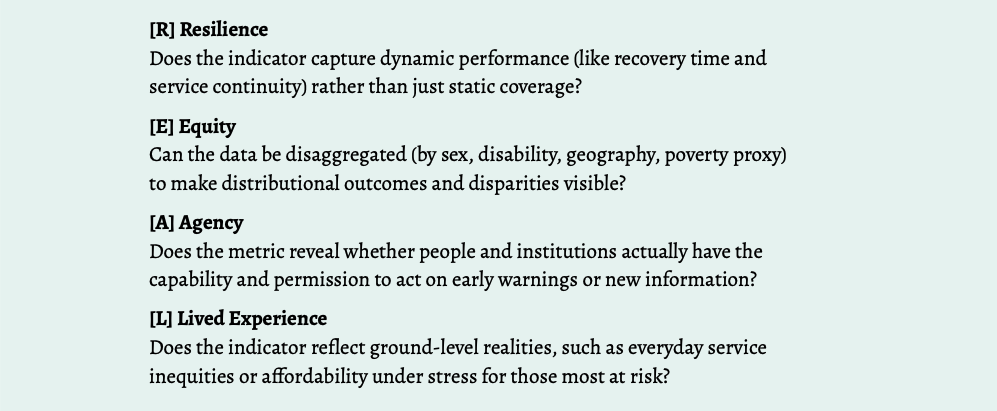
In that context, we developed a kind of rubric that evaluates any indicator according to lived experiences: the Resilience, Equity, Agency, and Lived Experience (REAL) rubric, which includes a gender lens. I really see this as so much more than a checklist, it has the potential to progress from ‘inclusion’ to ‘agency’ in the context of resilience indicator frameworks.
I really hope that this kind of framing helps to move from labels like “vulnerable” to definitions like “essential voices”, as they are essential to progress towards resilience.
The Water Resilience Tracker’s REAL Rubric for inclusive indicators. Read full report >