
Collaborative Power of the Water Resilience Tracker in Tanzania
In Tanzania, the mounting threat of water stress, driven by unpredictable rainfall and extreme weather, demands a shift from reaction and recovery to proactive climate and water resilience.
This transformation is currently being piloted through GIZ’s Water4Future initiative, supported by AGWA. It has two tracks: strengthening the national water and climate policy, planning and implementation framework to ensure the key work plans and budgets are coherent and harmonised across different social, economic and environmental sectors. The second track facilitates multi-sectoral diagnosis in order to develop robust, efficient investment pipelines that incorporate demands of different sectors and stakeholders.
The pilot area has been proposed for the fast growing Tanga City whose water resources are threatened by upstream degradation through smallholder agricultural activities in the Zigi subcatchment, part of the Pangani River Basin. The initiative uses the Water Resilience Tracker (WRT) process to integrate data, policy, and financing into a single, resilient framework that delivers both for urban water systems and reverse the water insecurity caused by water diversion, pollution and depletion of nature based storage.
A recent workshop with twenty-five public, private, and civil society stakeholders revealed that the WRT is far more than a technical instrument; it is a unique and valuable enabler of the cross-sectoral collaboration required to navigate the climate crisis.
Much more than a tracker
The workshop highlighted the WRT’s ability to actively break down internal government silos. Tanzania government staff were among the first to articulate the potential they see in the Water Resilience Tracker. By screening and strengthening sector workplans and budgets, the tool compels departments to move beyond isolated mandates toward a unified climate policy. As a senior official from the Ministry of Water Resources noted, the WRT’s capacity to evaluate project implementation on an ongoing basis, comparing real-world progress against expected impacts, enables continuous course correction, turning abstract planning into a dynamic, collaborative process.
Inclusion as a success strategy, not a checkbox
The workshop reiterated that no climate process can be successful or resilient if it is not inclusive. The WRT’s GEDSI framework elevates inclusion from a mere compliance checkbox to a core strategy for resilience. Participants moved beyond language of "ticking boxes" to developing implementable content that ensures gender, equity, and social inclusion are foundational to water governance, bridging the gap between high-level policy and field reality.
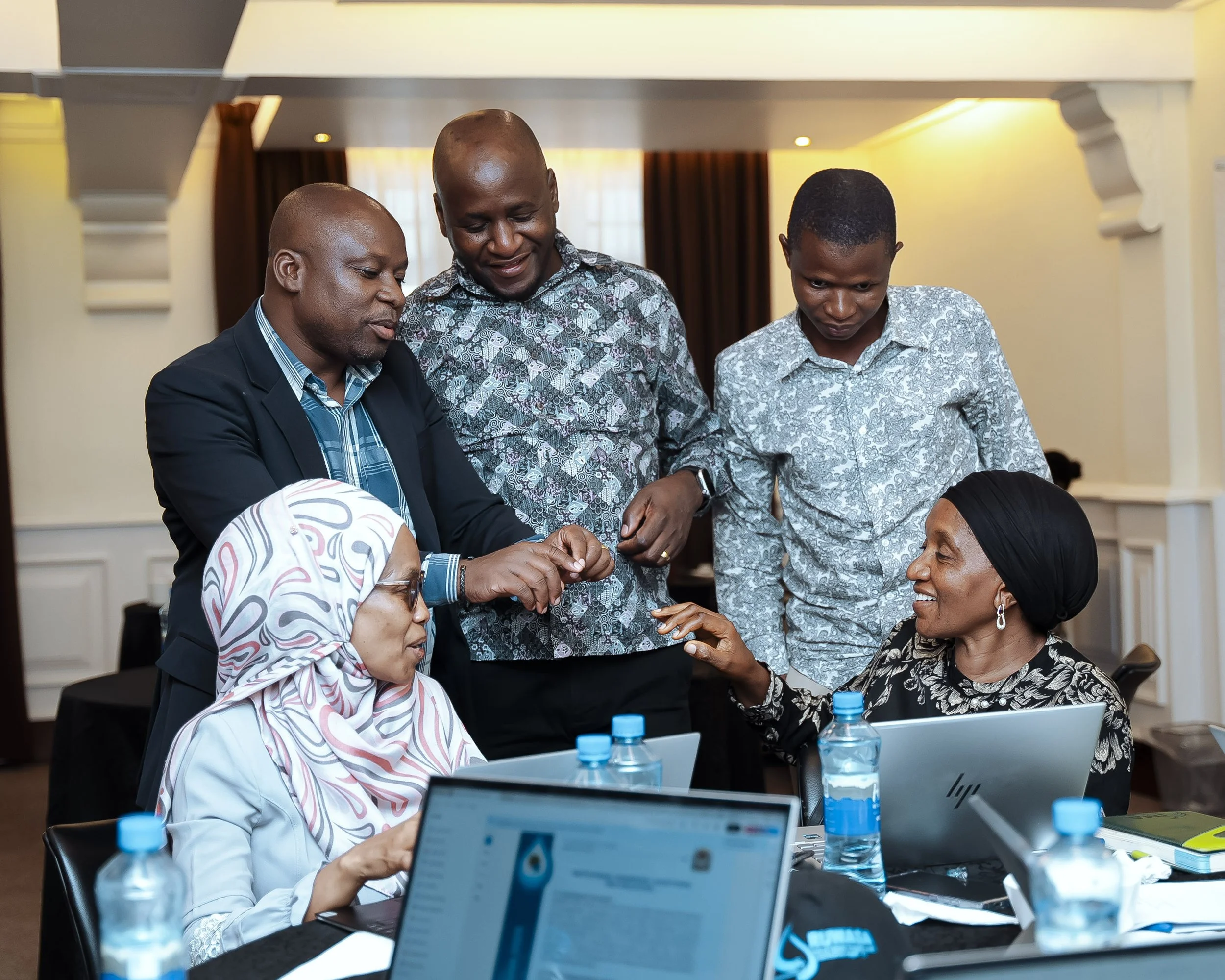
Participants during the workshop. Photo: GIZ
The team is as important as the tool
Experience in Tanzania confirms that a multidisciplinary government team composed of key departments, supported by major implementing and research institutions (NGOs, Academia) is the ultimate change instrument. To enable true cross-sectoral collaboration, the WRT demands a focus on skills such as stakeholder engagement, knowledge sharing and collaborative problem-solving. Positioning these as equally important as technical proficiency. This shift requires simplifying technical terminology to foster broader participation, ensuring that the technical insights of engineers, scientists and the lived experience of communities carry equal weight in the resilience process.
Looking Ahead
As the WRT expands through Water4Future’s pilot countries, the focus remains on ensuring that processes are inclusive to leave no one behind. Incorporating GEDSI perspectives into capacity building and exploring digital innovations to accelerate acquisition of data and simplify information analysis will be essential steps in scaling this collaborative model.
The work in the Tanga/Zigi region is more than a promising start; it is a definitive model for success. By refining the Water Resilience Tracker in this collaborative spirit, we are ensuring its impact will strengthen water’s contribution to resilience for cities, basins and societies around the world.