
My Sojourn to the Munich Security Conference: Peace, Love, Fragility, and Water
It’s been hard not to think about conflict, fragility, and security over the past few weeks — especially the past few days. Missiles have rained down on Iran’s Qeshm desalinization plant in recent days, followed by similar attacks on Bahrain’s desalination plant in retaliation. Why these plants? Desalinization has become critical to the livability of the countries lining the Persian Gulf and Red Sea, so these are ultimately attacks on the whole population. According to International Intriguer, “Desal provides nearly all drinking water (in this region) — we’re talking 90 percent for Kuwait, 86 percent for Oman, and 70 percent for the Saudis.”
Indeed, about two weeks ago, I was wandering around old, narrow streets near the Munich Security Conference. This was the second “security” meeting I’ve attended — the first was high in the Alps in Slovenia in the late 2000s. Back then, Slovenia’s foreign minister was hosting about 100 ministers and military and intelligence personnel; the keynote was given by the US general (Colin Powell) who oversaw the First Gulf War in the early 1990s, and then led the US State Department during the Second Gulf War a decade later. I seemed to be the only person invited to speak without a bodyguard in attendance (when I left my hotel room early one morning for a run, I had to raise my hands in supplication when two armed guards saw me as a potential threat). I was way out of my depth.
While I was there, I worked with Slovenia’s government to prepare a statement delivered later that year by Slovenia’s president to the UN General Assembly, emphasizing that climate impacts on the water cycle could destabilize economies, populations, and ecosystems. Water resilience was a global security issue. In 2010, a larger group of countries in what was then called the “green group” made a similar statement before the UN, building on Slovenia’s leadership with more strength and clarity. I remain proud of that collaboration, which marked some of the first attempts to lift water resilience to a more systemic level within the UN system.
Between 2008 and 2026, the world has become a much rougher, less well governed place but those issues have only become more important. And the ideas I had started to explore with diplomats and the “security establishment” in the 2000s feel very present, very clear right now.
The confluence of a devastating drought in Iran and longstanding poor management within the country apparently fed much of the public unrest late last year before the conflict became internationalized. Tehran had already reached day zero status this year, with President Masoud Pezeshkian suggesting that parts of the city may need to be evacuated because of the difficulties in suppling them with water. In provinces like Ilam and Khuzestan, tankers frequently deliver domestic water supplies, a visible failure of the national government, in addition to regional diversions that have been widely interpreted as favoring particular ethnic groups. This has shifted the public's perception of the state from one of authority to one of “visible failure.” Of course, the national grid has a significant (and significantly underperforming) hydropower component, while its water-cooled thermal systems also show evidence of extreme water stress — energy critical for powering desal operations. And then there’s the country’s agriculture…. It’s hard not to see the influence of water intensifying social and political tensions in the country and the escalating water-climate tensions for regional security.
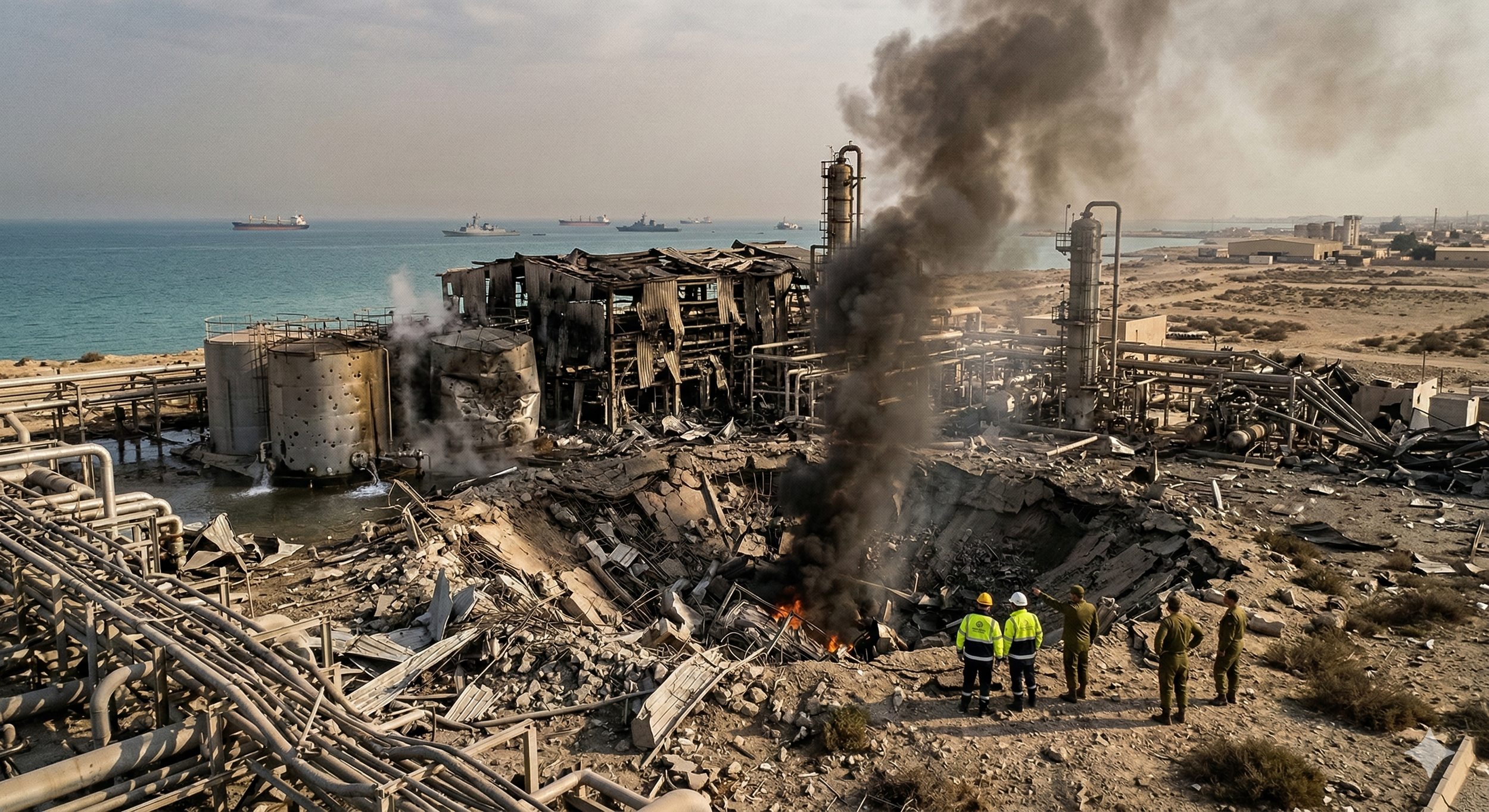
Image generated by Gemini AI
And thus I found myself in Munich. The MSC is much larger and more prominent than what I had attended in Slovenia, and indeed I couldn’t get in to see the really important discussions — walking around, I thought: This is Davos with guns. I was attending as a personal experiment to see if I could find a pathway into what seems like an increasingly pressing set of issues.
Even then, we could feel the threat of conflict between Iran and the US and a larger set of instabilities between the huge region spanning Cyprus and Pakistan, the Caucasus and the Arabian peninsula (on a flight from Sri Lanka to Bavaria, I watched my plane carefully avoid almost all of this landmass, diverting into presumably safer missile-free airspace far to the west).
The military and intelligence communities have — very correctly — come to understand climate change as a “threat multiplier.” The Munich Security Conference is the largest and most prominent meeting for these communities. I’m not sure I’ve even been to a meeting with more generals strolling around in uniform, and what were all of those high-security ultra-reinforced steel briefcases? Beyond Iran, Ukraine, Russia, Greenland, and Gaza were in the air.
But seeing so many uniforms is a reminder that “security” is mostly about insecurity — about fragility as the opposite of resilience. I was surprised by how many corporates were there too. On one panel, I was listening at close range to the CEOs of Bayer (big pharma), BASF (chemicals), and a huge European steel company, among others. While they expressed concerns about trade pressures from the US and China, they mostly seemed worried about how Europe itself was evolving — and their difficulties in keeping up with pressures ranging from energy to inflexible regulations. The US and Iran, yes. But everyone felt that the system was tilting and distorting in new and strange directions. I suspect many attendees are wondering about what we can expect later this year, following the forecast of a “super” El Niño.
Impacts on the water cycle are clearly fraying institutional and social connections, prompting conflict over resources and straining economic systems.
In AGWA, we believe that water is not just a hazard or a mechanism that intensifies other threats. Water has the potential to be a resilience multiplier, promoting political and social stability, aligning investment and prosperity, ensuring that communities and economies can do more than just weather climate impacts — they can plan for a more secure future and thrive.
Was water fragility the first complaint in Iran, by the CEOs I heard, or by the generals and intelligence officers? No, in the same sense that we tend to focus on the most urgent and obvious issues in an acute medical emergency — the heart attack happening before us, not the decades of smoking that led to a cardiac arrest. And yet!
I also attended a small closed door session focused explicitly on the security dimensions of water and climate, led by the Eurasia Group and expertly keynoted and summarized by J. Carl Ganter from Circle of Blue, comprising corporate, UN agency, big NGO, and various “security advisors.” The Eurasia Group published a global risk assessment with an important analysis on just this issue early in 2026. Through a Chatham House filter, I can say that water and climate were widely seen as a systemic and often destabilizing threat to economic and political systems, but the concept of resilience seemed both widely unfamiliar and intriguing to many in the group. It felt like a lot of capital — financial returns, as well as the credibility of our political institutions — was at stake in the intersection between fragility and resilience.
My conclusions from Munich?
The global diplomatic and political landscape is undergoing major changes — changes that feel more like a transition than a new set of stable relationships. The intelligence and security communities are right to talk about water as a fragility “accelerant” or threat multiplier or as a systemic risk, but they also have something important to learn from us: water is more than the liquid water we can all see. It’s a full cycle, from the oceans to the atmosphere and both above and below the land. The risk landscape will not be clear unless we are looking at the level of water as a cycle.
But the emphasis on fragility and risk also ignores a lesson well articulated by the voices of people like Susanne Schmeier, Aaron Wolf, Lynette de Silva, Melissa McCracken, and Aaron Salzberg: water can be a binding agent. Moreover, AGWA’s emphasis on water resilience is a preemptive approach to reducing fragility and seeing (and investing in) the political, economic, and ecological systems touched by freshwaters, what we have called “natural security” as an extension of national security.
The water and climate community should be at these meetings — and perhaps the generals and diplomats need to be at ours too.
Echoing Carl Ganter’s smiling words and mindful of the season of Ramadan, Passover, and Easter, I hope we can make these security conferences the equivalent of Davos with (harmless) water pistols rather weaponized waters.
John Matthews
Corvallis, Oregon, USA