
On Davos and Dakar
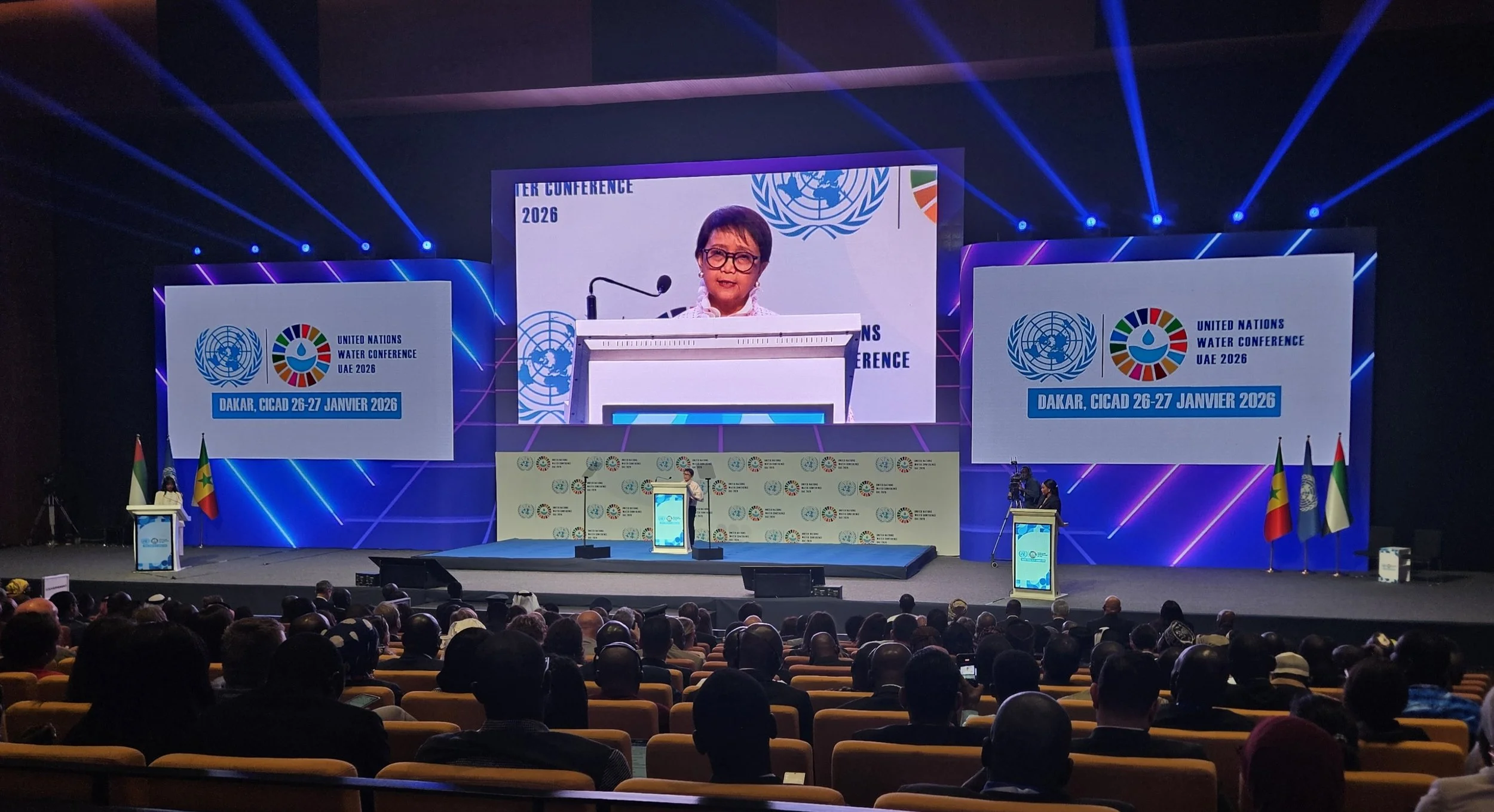
Last week I was in Senegal for a 3-day meeting to prepare for the next United Nations Water Conference–taking place in the UAE this December. Our Senegalese hosts did a wonderful job of convening a robust mix of countries, UN Agencies, intergovernmental institutions, and non-state actors.
The goal of the meeting was to lay the groundwork for the conference and set expectations for participants. However, due to logistical challenges as well as the late appointment of thematic dialogue co-chairs, the preparatory meeting focused on gathering input from Member States and stakeholders on what they’d like to see highlighted in Abu Dhabi, with little clarity on the expected roadmap and outcomes. The meeting summary report, which will be published by the Co-Hosts soon, promises to include some of these next steps. We will of course share them with our network members as soon as we have more clarity.
In the meantime, a couple of reflections from my side. The timing of the Dakar meeting was such that it took place just after the close of the World Economic Forum in Davos, Switzerland. This year’s Forum included several buzzy speeches, but the one that really stood out was given by Canada’s Prime Minister, Mark Carney, who called for a new “principled pragmatism” in response to the ongoing rift in world order.
At its best, Carney’s speech clearly articulated the uncertain geopolitical moment in which we find ourselves and was meant to inspire the many countries who find themselves increasingly squeezed by the unconstrained tyranny of so-called “great powers.” He urged the creation of values-based coalitions of the willing, working to address individual challenges collectively so that middle power countries can keep a seat at the table, not on the menu. It was a nice bit of rhetorical flourish, though I suspect many of my colleagues from lower-income countries rolled their eyes a bit at this line, having never been afforded the choice between eating or being eaten, but that’s a different essay.
On stage in Dakar, I heard excerpts of Carney’s Davos speech quoted no less than six times. Speakers extended Carney’s metaphor about either being at the table or on the menu to the realm of water and called for a bigger table as a response. They also expressed apprehension about the future, and the need for multilateralism to be strengthened, not weakened, as a response.
While the agenda of the next UN Water Conference is nominally about a recommitment to the 2030 Agenda, it was clear that most people in Dakar were more interested in thinking about what comes next. When it comes to global water governance, how do we meet this bigger moment? How do we set ourselves up for success in the post-2030 period? I was pleasantly surprised by the forward-thinking tenor of the conversation, because, like many of you, I believe we have no time to lose.
These questions went largely unanswered, focusing instead on reinforcing existing systems and frameworks, even though these systems have never worked for water. Taking the 2030 Agenda and simply slapping a new date on it is not a real solution.
I appreciate that these suggestions were made from a genuine sense of concern that it will be difficult to be ambitious and, thus, we must cling to what we have. I am certainly sympathetic to such concerns. But to return to Carney’s Davos speech, I wonder if those quoting his lines about pragmatism did not listen through until the end where he cautioned that this moment calls for honesty about the world as it is, that “the old order is not coming back, nostalgia is not a strategy.” Instead, we must articulate a clear-eyed vision about what is possible in this new world.
The same week as Davos, a new global water report was released by the United Nations University Institute for Water, Environment and Health (UNU-INWEH) entitled: Global Water Bankruptcy: Living beyond our hydrological means in the post-crisis era. This excellent paper calls out in plain language what many of us have been saying for years: human beings have created structural water imbalances in nearly every region of the world. As a result, we must fundamentally re-think our strategies for sustainably managing what remains of our shared water resources.
Like in geopolitics, we are at a point of rupture when it comes to water. The old rules based on stable, stationary hydrology, no longer apply and cannot save us. We are living beyond our planetary boundaries. We need a new relationship to water, and we need rules and governance systems that reflect this reality. The fragmentation that currently plagues water governance at all scales and across all sectors must be addressed – within the UN system, at national, local, and regional levels, and within companies, institutions, and financial institutions.
Within the UN system, the System-Wide Strategy on Water and Sanitation was a first attempt to address the issue of fragmentation on water across UN Agencies. Unfortunately, this strategy has not yet been effective for several reasons, including the fact that the UN system was never designed for – and actively discourages – coherence and collaboration on cross-cutting issues like water.
Conversely, where the UN has been essential is in raising political awareness, setting priorities, and helping to direct funding. It can certainly be more effective, but there is a real need for support from water champions at the highest political levels. Appointing the UN Special Envoy on Water was an important first step, but she cannot be the only one. In addition to establishing a new global framework for water governance, it would be fantastic if the next UN Water Conference could identify and empower these leaders.
But simply fixing fragmentation without addressing the underlying structures is not enough. A new vision for water governance recognizes that water is a strategic asset for economic growth and prosperity and manages and protects it as such. Water is not limited to WASH or wetlands, pipes or pumps. Water is a system and it must be managed in a way that holistically integrates the diverse aspects and users of the resource to ensure the resilience of the system in its entirety.
This is both a top-down and bottom-up endeavor:
Global frameworks must recognize the systemic nature of water and prioritize basin and aquifer-level management, as well as the principle of equitable and reasonable utilization.
At transboundary levels, enhanced river basin organizations can support upstream-downstream coordination, learning, and monitoring.
At the national level, centralizing water management within ministries of finance and planning can help to promote cross-sectoral water planning.
Locally, water managers can work with communities and companies to develop locally-appropriate management plans and support knowledge sharing, innovation, and adaptation.
I will close by saying that I think water is an excellent candidate for Carney’s vision of values-based coalitions of the willing. Developing water resilience is a shared activity with co-benefits across a range of issues including peace and security, economic productivity, energy and food security, biodiversity, and disaster risk management. It is fundamentally a local resource but is best when managed at multiple scales. Regional cooperation will be essential in this new water world. While transboundary cooperation is currently trending in the wrong direction, countries should recognize that they are much stronger working together on water than in isolation.
The 2026 UN Water Conference is arriving at an important moment for the international community. Water can help define a new generation of multilateralism, one focused less on a single hegemon setting the rules and conditions and more on diffuse, dense networks of cooperation at all scales. As my colleague from IUCN, Sofie Jaffe, pointed out in her remarks in Dakar, we don’t need to have all the answers today to start the process of defining what comes next, but we do need to take the first step by articulating a shared vision and setting the direction of travel. This is AGWA’s position for the 2026 UN Water Conference and we are keen to work with others who share our commitment to pushing for a new vision of global water resilience.