
Water Resilience Stress Testing for Dummies
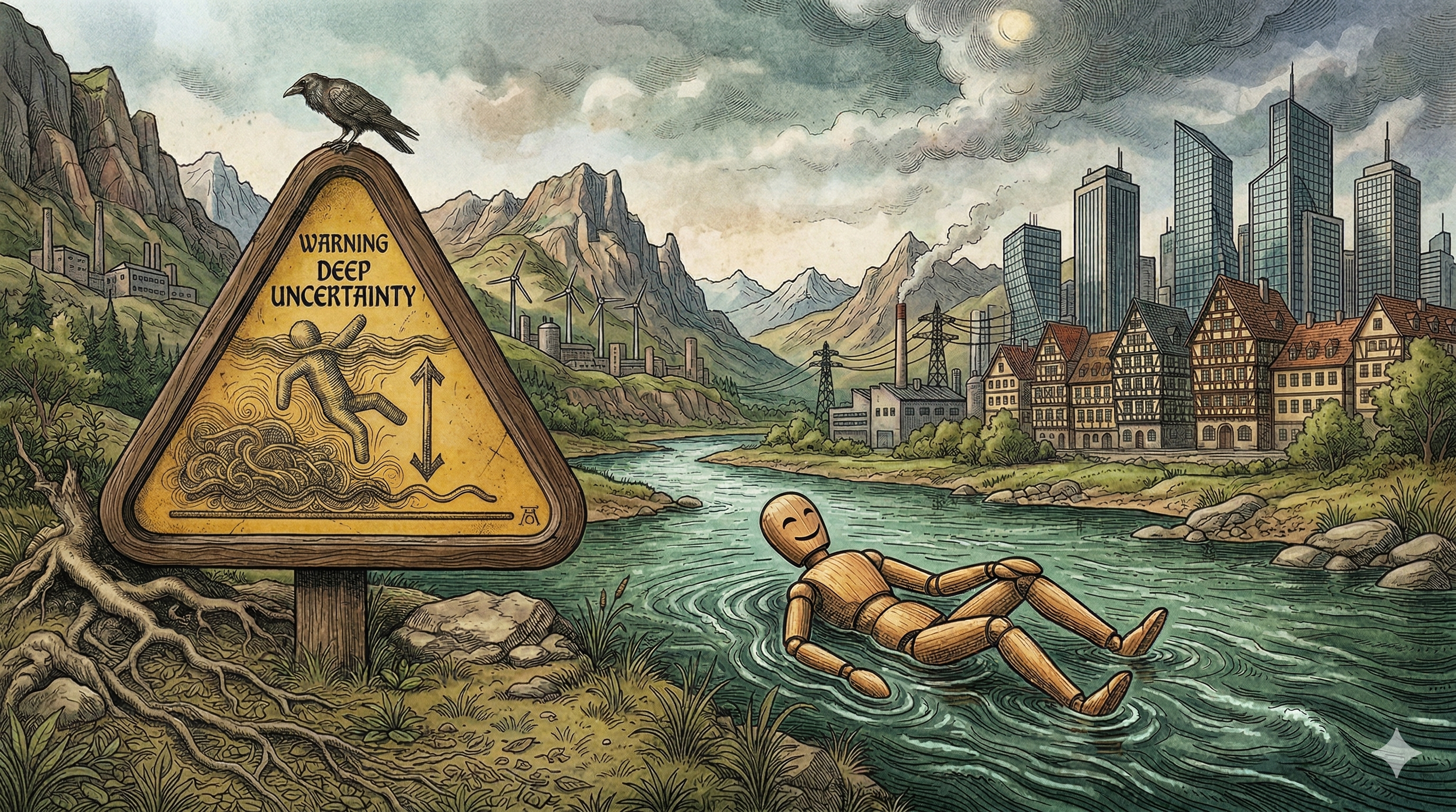
Gemini AI generated, prompted by Nikolai Sindorf, 2026
Relax. You are not the dummy.
The dummy is the model system, the design event, the return-period number we line up against a project and call a test of resilience. The question worth asking here is whether the dummy still resembles the system we are actually trying to sustain, because most of the records we anchor our designs to describe a climate and a landscape that are no longer the climate and landscape we live in. As we keep adding years to those records, the latest ones increasingly arrive off the charts, and yet who chooses the dummy, and for what reasons, is rarely on the table.
The reservoir that was always full
In one large reservoir in the Southern United States, retired water engineers had drifted into advisory roles paid by the power utility and the local boating club, and their job, in practice, was to keep the lake level high throughout the year: maximum head for the turbines, maximum surface area for the boats. Both came at the cost of flood protection and downstream conservation, which were the interests I represented at the public consultation.
The original operating rule had asked the right question: at any given date, what reservoir level would prevent downstream flooding in a 1-in-100-year event? For final approval by the public consultation, quite strategically, the rule was inverted into a different question, namely, on any given day, what is the chance that the 1-in-100-year flood actually arrives? Phrased that way, the answer is always small, which conveniently means that the level can stay near maximum all year round. Generation revenue, held to the brim. Surface area, maximised for pleasure-boatin' perks. Both dressed up as risk analysis.
When I raised these concerns, the engineers’ response was that it was unclear what an outsider, one who did not even speak proper American, could possibly know about the operations of this reservoir. That, too, was another way of framing the dummy.
The floodplains that flooded
In another setting, this time in Asia, a conservation organisation raised the alarm that its floodplain projects were being overwhelmed by what it called unprecedented floods. The framing was climate change, and the funding pathway was climate emergency.
The situation was real, and at least partially climate-attributable. But when we looked at the numbers, the flood event had reached roughly 25-year levels, which is something any floodplain project should have been able to absorb, if not actively welcomed. The project had simply not been designed for it. Climate proofing had not entered the design brief at all, despite the climate and hydrological signals having very obviously changed around it. The strange part, for a floodplain project of all things, is that this is not unusual.
When that gap is later relabelled a climate emergency, the dummy ends up doing two jobs in sequence. It first covered the original design, which was undersized from the start, and then it covered the rescue, by lending that same failure a more sympathetic name: not bad design, but bad climate. The floodplain as a resilient system, which was supposed to be the beneficiary of both rounds, ends up seeing the benefit of neither.
The Event Formerly Known As A Flood In 100 Years
The 100-year flood as a hydrological statistic is, in many basins, no longer a 100-year event. The underlying thinking remains useful; it is just that the labels we attach to it no longer match the extreme events they were built to describe. Statistics, etymologically, is the science of how a system stands. When it stops standing still, the science keeps describing it as if it had not. Kinetics is the science of how systems moves. We are still using the first to describe a system that requires the second.
Consider, by way of analogy, the musician who replaced his name with a symbol. At the time, the move was explained as a new artistic direction, a break from his earlier identity. Coincidentally, it also released him from the contracts attached to his old name. The art continued. The contractual obligations did not.
We can do something similar here. Call it TEFKAF100, or TEFKAD50 for the drought version. The function carries over intact: magnitude, duration, seasonal shape. What quietly falls away is the statistical contract embedded in the old name, namely the statistic of a 1-in-100 chance in any given year of a stationary climate.
So, every time you read about a "1-in-100-year event", here or elsewhere, it deserves the same mental footnote. Of which reference climate, exactly?
Bringing governance into the stress test
Stress testing in the CRIDA tradition (Mendoza et al., 2018), and in Albano's 2021 elaboration of it, is mainly quantitative or narrative. You push the system with plausible but uncertain drivers, you see what breaks, and you redesign accordingly. That work is necessary, and it is well established and evolving. But in practice it usually stops at the physical and hydrological boundary of the system. Governance is part of the system too, yet conventional stress tests rarely reach it.
The two cases above were not modelling failures. They were governance failures under stress. Both of them needed, and neither of them got, the same set of questions: when the dummy turns out to be wrong, who decides what happens next, who pays for it, and who bears the risk that has been quietly transferred elsewhere in order to keep someone else's lake full.
At AGWA, together with GIZ's SecBlue, we are currently exploring a new approach designed to bring those questions onto one page next to the conventional stress test. We call it the Water Resilient Portfolio Tracker, and it is designed to work on development projects in particular to build on best practices in climate-water resilient project planning. Informed by systems thinking and a stress-testing matrix, it asks the kinds of questions that only become visible once governance is treated as part of the system being tested: under stress, do the project outcomes hold, do the financial arrangements continue, and does the decision pathway stay clear?
We are currently exploring the approach beyond development projects, into value chains, and there is no obvious reason it should not also work on reservoir operations, on floodplain conservation, or in any other CRIDA setting.
That is a version of stress testing worth adding. The rest is performance.
Nikolai Sindorf
Balangan, Indonesia
Enjoy reading essays like this? Please subscribe to the AGWA family of newsletters! You can join AGWA and subscribe here.