
Coursing Connectivity and Time in Transforming Riverscapes
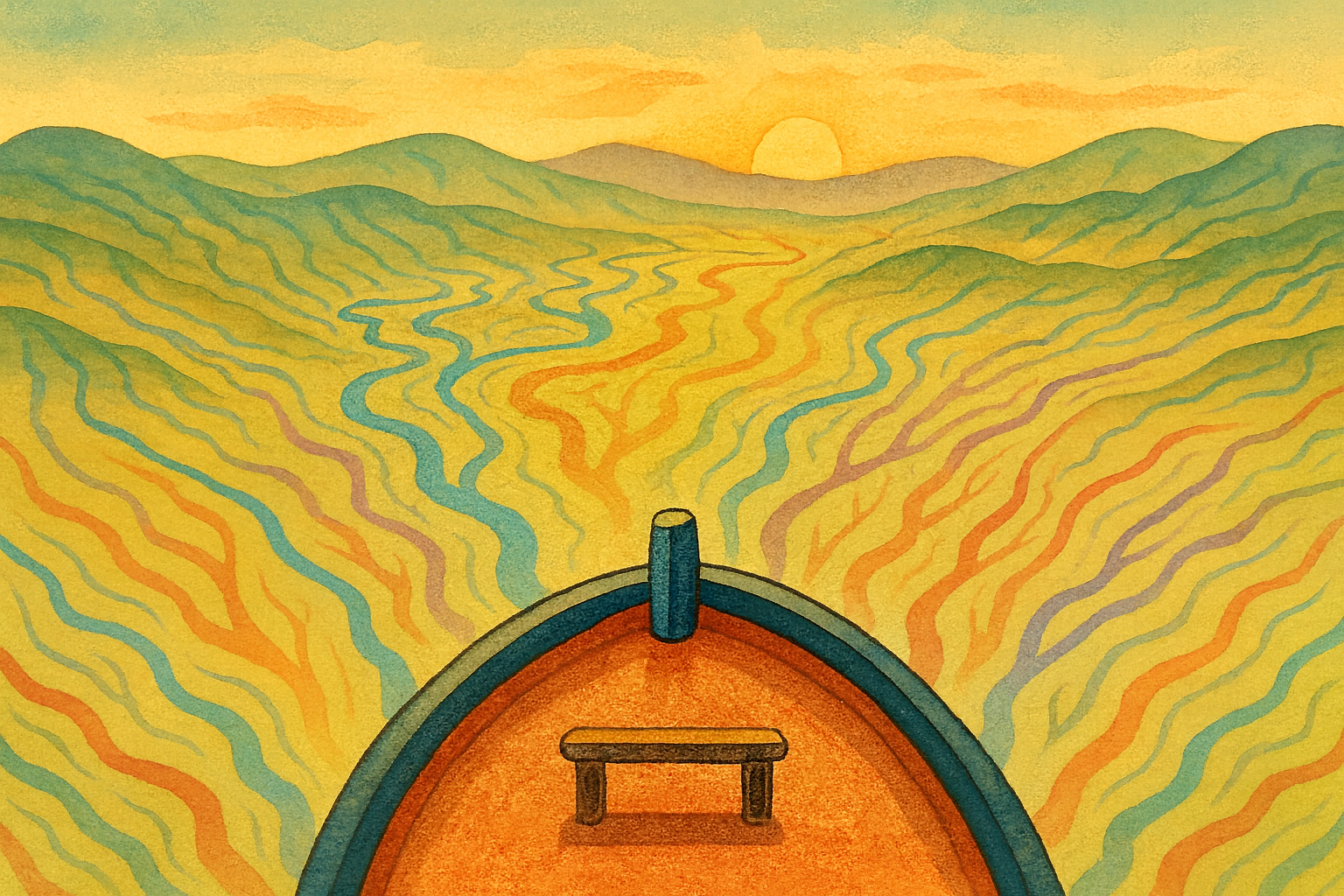
Some children books leave a lifelong presence. Scuffy the Tugboat * written by Gertrude Crampton and illustrated by Tibor Gergely is such a book. In 2026, the book will be 80 years old, but I just read it 18 years ago for the first time, for my daughter. In the book, Scuffy complains that he is meant for bigger things than to float in a bathtub, so he is allowed to float around in an upstream brook, but Scuffy quickly sails away to explore the big world. The book follows him as the brook grows into a small river and as the small river grows into a big river. As the river grows bigger, so do upstream villages grow into downstream towns and into a big city and we see the actvities along the river change as we float downstream. The book probably might have had more impact on me than on my daughter...
My introduction to the book more-or-less followed with my first explorations of HydroSHEDS: a global digital mapping system that shows where water flows across Earth's surface, including rivers, streams, lakes, waterfalls, and drainage basins, helping scientists and planners understand and manage water resources. HydroSHEDS emerged from Bernhard Lehner's vision and was launched in 2006 by WWF. I was lucky, starting in the same lab that year meant witnessing the behind-the-scenes work, the launch and its early applications and breakthroughs. Nearly 20 years on, HydroSHEDS has been my faithful guide through every eco-hydrological challenge, the first tool I reach for, the one I trust most. HydroSHEDS and Scuffy that is.
The main strength of HydroSHEDS is that it puts consistency into connectivity and scale in river systems; you can compare water systems on any place of the world with another. Over the years, the information system behind it has grown with HydroATLAS, which provides extra layers of information mapped on the river networks. Layers such as different river types, or the number of people living upstream, or water use, or glacial sources, or land cover, among many other layers (over 75). An updated version, with will be more accurate and consistent, is to be launched soon, HydroSHEDS 2.0, at twenty.
Apart from being used as a source for Minecraft real-world game-maps, HydroSHEDS has many other uses, ranging from conventional assessments on water risks, ecosystem services, hydropower planning, ecological and functional flows, to more atypical applications such as:
Scuffy might have been the most eager toy in the shop; his actions created a narrative that is still inspiring in how to course a river from the source to the sea. It is a bit dated, but, in retrospect, offers a valuable lesson on how much a culture (mid-20th century, American industrial-era) evolved around river systems and by doing so, it provides a snapshot that endures. I see the story as a sort of 80-years old version of Street View, but for rivers. Speaking of which, you can explore your inner Scuffy here: Amazon (Rio Negro), Colorado, Danube, Mekong, Mississippi, Seine, Tanganyika Lake, Thames. Toot toot!
HydroSHEDS navigates river systems from many sources to many seas and back again, a stepping stone for modeling from problems to solutions, from past to future. As a scientific tool, it requires mastery, involving a steep learning curve rooted in Geographical Information Systems expertise. This complexity mirrors the challenge of understanding any river system: connectivity remains consistent while meanings shift with each question we pose. The real potential lies in developing applications that translate HydroSHEDS' insights into answers for real-world resilience challenges; helping communities prepare for floods, planners balance development with ecosystem health, managers allocate water under climate stress. A few years ago, it was, for example, at the basis of AGWA's intital work on developing functional flow indicators for South Africa's Biosphere Reserves, where the approach was presented to and supported by the biosphere communities.
Both Scuffy and HydroSHEDS take me on a journey along the rivers. But what are the possibilities when we combine Scuffy's curiosity, HydroSHEDS' rigor, and resilience thinking? River locations backed by historic imagery, updated regularly and consistently; perhaps following a Street View approach**. This approach could help, if we commit to consistent global coverage from the start; to be able to compare resilience pathways across global geographies. Regular updates capture seasonality. Consistent coverage ensures places like Africa aren't left out. Together, they'd reveal how surface water systems evolve and adapt under changing conditions: shifting seasons, floodplain development, and more. What works? What doesn't? This combination would have the potential to become part of our shared resilience narrative. I am open to suggestions to explore such a setup together in the near future.
Nikolai Sindorf
Delft, Netherlands
* this link includes the full 8 minute readalong
** Street View type imagery is sometimes applied in scientific studies, e.g. Yi et al. (2025) used deep learning on Street View to quantify greenspace around children’s homes and linked that to cardiovascular health indicators.
Enjoy reading essays like this? Please subscribe to the AGWA family of newsletters! You can join AGWA and subscribe here.