A Field Guide to COP: How to Navigate COP31 for Water & Climate
Written by John Matthews & AGWA
In 2026, Türkiye and Australia will co-host the 31st Conference of the Parties (COP31), which will take place in Antalya, Türkiye, this November. The COPs are the largest global United Nations event for discussions and negotiations on climate change. The meeting is held annually, with the presidency rotating among the five UN-recognized regions. The UN Framework Convention on Climate Change (UNFCCC) was founded in 1992. Its role has evolved greatly and can be expected to keep changing in sometimes dramatic ways. Indeed, the complexity of the institutions within the UNFCCC — the so-called subsidiary bodies — forms a kind of rival to the larger UN system itself. The COP meetings partially reflect this complexity, compounded with many other competing agendas from member states, international institutions, and civil society.
This “field guide” is intended to serve as a primer to the COP process and landscape; we published it first in 2025 for COP30 in Brazil, with updates included for this year’s COP31. Our hope is to reduce “COP tourism” and increase the number of credible and relevant actors working on climate adaptation and resilience issues, especially with regard to synergies for water and climate issues. Adaptation and resilience have slowly and gradually increased in importance in the COPs, but not always in ways that are clear, with obvious points of influence, or easy to access and understand. Sometimes we can see significant movement at the global level. More often, the easiest mechanisms for forward movement are at national, multilateral, and civil society levels.
Who Goes, Who Doesn’t
The climate community is not evenly represented at COP, and this year promises to be different from previous conferences. Since about 2022, the “climate exposition” component of COP has been increasing, with many attendees engaging in what can be described as COP tourism for social media hits.
More NGOs and companies touting services and their accomplishments have also been driving up numbers. Strategic advisor firms such as McKinsey and the Boston Consulting Group (BCG) over the past three years have been important, forming some of the largest delegations at COP29.
Multilaterals are well represented, ranging from UN agencies supporting UNFCCC processes (UNDP, UNEP); climate finance funds such as the GCF and GEF; development banks; and intergovernmental groups such as the OECD and IUCN.
The UNFCCC, of course, is very well represented in numbers but may not be very visible; they have their own offices and spaces, and their senior teams are often concentrated around the negotiations. Climate finance is overwhelmingly multilateral in nature but with a small and growing private investor group representation.
Typically, attendees from all of these groups — if they are planning on entering the diplomatic or higher-security “blue zone” — are high-level and senior staff. The Asian Development Bank, for instance, may send less than half a dozen employees, despite climate change being a major priority and actively participating in many other pavilions.
Working level government officials, i.e., leading individual projects or programs, are rarely in attendance unless they are high-profile. The new resilience team at the UK FCDO, for instance, may not be represented at all at COP31. The UK’s prime minister will attend, with a handful of support staff.
Increasingly, you see media and subnational groups such as accredited indigenous peoples and youth organizations at COP.
Countries (“parties” in UN terminology) can theoretically have very large delegations, and some NGOs and companies may attend with “party overflow” badges in the blue zone rather than with badges from their own institution. The host country typically has a large delegation, as do the previous COP host and the (potential) future COP host(s). Bilateral groups are represented too. US AID traditionally had a large and tightly scripted pavilion. Groups like Sida or AFD were far more limited in attendance and embedded within the Nordic or French or EU pavilions, respectively.
Party attendance is variable in level. Middle and lower income country delegates often include both negotiation and NDC and NAP leads and support teams. They will move actively between the negotiation and national pavilion spaces. Country population or wealth may not be very well correlated with delegation size. Singapore sent a large delegation to COP29, as did several small West African states. However, funds for delegate support have been reduced in recent years, making it harder for smaller and less wealthy countries to send many representatives.
Brazil and the UNFCCC made 2025’s COP30 somewhat different, reining in delegation size in the blue zone. COP28 Dubai had something approaching 120,000 attendees, which was at least twice as many as any previous COP. COP30 had roughly 40,000 attendees, with a limited online attendance — total attendance was probably the lowest in a decade. Estimates for 2026 are probably the same or slightly higher than 2025.
The Geography of Engagement
The climate policy conference cycle has some reliable points of reference over the course of the year: Accreditation is necessary for most UN climate events, and accreditation is itself a complex and time-consuming process, especially for non-party actors such as NGOs and companies.
COPs have evolved into complex multi-purpose events since the 2015 Paris Agreement, consisting primarily of a blue zone and a green zone. The green zone’s purpose has evolved over time but is largely public facing and focuses on publicizing climate issues; accreditation is not necessary, and many individuals and groups in the green zone may have little or no awareness of the negotiation processes in the blue zone. At times, the green zone has felt like an afterthought or intended to educate local schoolchildren. At some COPs, the green zone has been an intensive space for businesses to host pavilions and events on climate-relevant topics.
The blue zone requires diplomatic accreditation and a special pass, with security systems going in and out. In general terms, the blue zone consists of a negotiation space, a pavilion space, an events space, and offices for particular delegations, especially parties and intergovernmental groups.
The oldest part of the COP is the negotiations process, and this is where staff from the parties are concentrated, though the number of individuals at any one time there may be quite limited. This is the most formal part of the COP as well, typically focused on specific language, agreements, and processes. Often the negotiations space is segmented far from the “exposition” parts of the COP (e.g., where the national pavilions are located), with the meetings shown on TV screens. The negotiation space has evolved less than other parts of the COP. As with most diplomatic negotiations, there are observers and parties, and access may be very limited, even over the course of an individual session. Language and protocol are scripted and managed very rigorously. Observers typically have specific seating areas in meeting rooms. In our experience, non-party attendees in both the blue and green zones rarely attend the negotiations and may not even have a clear idea about where the negotiation space is located. The exceptions to this are groups and organizations that follow specific negotiation tracks, such as those following Article 6 or Global Goal on Adaptation (GGA) negotiations. But seating for observers in the negotiations rooms is often limited and security outside carefully manages who is allowed to enter a given negotiation.
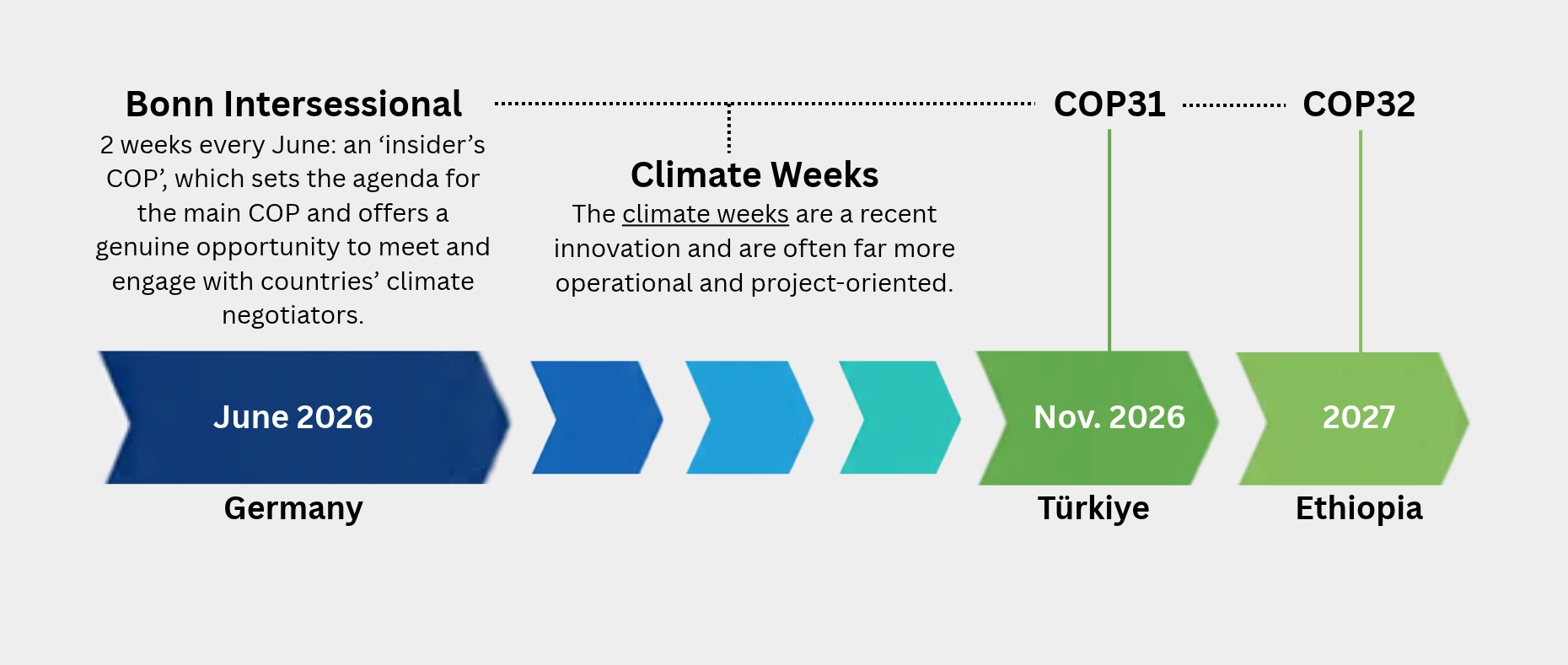
The agenda for the COP is largely set during the June intersessional conference in Bonn, Germany, during a meeting called the SB, which stands for the Subsidiary Bodies of the United Nations Framework Convention on Climate Change (UNFCCC). The COP presidency helps to organize and set the agenda. The presidency is a special diplomatic appointee from the host country; there are two and sometimes three: one incoming, one current, one outgoing. The COP president can often help direct issues or set out some priorities and also organize specific presidency events. The president sometimes also takes a very active role in communications. The president of COP31 is Murat Kurum, the Minister of Environment, Urbanization and Climate Change of Türkiye.
Each COP president sets a thematic agenda in line with host country priorities and organizes high-level events in the blue zone around those themes. The president also organizes a Leaders or Heads of State meeting during the COP where new commitments from both parties and select non-state actors are announced. It can be seen as a bit of a side show, but inclusion in these events is competitive and can help reach a different audience, including parties.
The presidency priority for 2026 is “implementation,” specifically of NDC priorities, that have been described in a COP31 Action Agenda. This agenda includes:
Clean Energy Transition and Electrification: Expanding electricity's share of global energy consumption to 35% by 2035 and launching initiatives like the Antalya Compact for Energy Efficient Buildings.
Zero Waste and Methane Reduction: Cutting projected growth from solid waste by 50% and increasing the global circular material-use rate to at least 15% by 2035.
Climate-Resilient Cities: Promoting sustainable urban planning, green building standards, and measures to combat extreme heat.
Green Industrialization: Advancing low-carbon industrial models and pilot projects supported by the AI for Clean Tech initiative.
Youth and Education: Ensuring climate action education for all by 2035 and promoting green jobs.
Food Security: Transforming agriculture and food systems into resilient, sustainable models.
Oceans and Seas: Enhancing marine ecosystem resilience, blue carbon integration, and regional data sharing.
Dynamic and Resilient Health Systems: Building climate-resilient health infrastructure and early warning systems for disease outbreaks.
Rio Synergies: Strengthening cooperation across climate, biodiversity, and land agendas.
Climate Implementation Bridge: Connecting national climate plans (NDCs) and Biennial Transparency Reports (BTRs) with bankable project pools and investment streams.
The incoming and outgoing countries also name one Climate Champion each — serving two years in total, with two serving at the same time. They are part of the Marrakech Partnership for Global Climate Action (MPGCA, dating back to the Marrakesh COP in 2016). The MPGCA has led to a lot of positive momentum in the COP by serving as a platform for non-state actors to have a voice. That is the purpose and intent of the MPGCA. They vary a lot in quality. Some are very active and approachable. Many are not and seem to be serving more personal or national interests. By intent, they should be representing civil society, indigenous groups, non-state citizens, companies, and other groups that are not characterized as countries or multilateral institutions. The COP30 Climate High-Level Champion is Dan Ioschpe, who is a Brazilian business leader who serves as the chairman of Ioschpe-Maxion, holds board positions at companies like Embraer and WEG, and chaired the B20 business forum during Brazil's G20 presidency. The COP31 Climate High-Level Champion is Samed Ağırbaş (President of the Zero Waste Foundation and former UN-HABITAT special advisor/consultant).
The champions specifically lead two programs: the Race to Resilience (adaptation) and the Race to Zero (mitigation). These are day- or multi-day-long events and require a lot of effort. They occur in the blue zone. Access to the champions can help with media and influence if they are being effective. They should be a focus of building a relationship. They can also organize other topics and issues, such as Activation Groups or the Sharm El Sheikh Adaptation Agenda. Water has been irregular in its appearance.
The MPGCA (or increasingly just the GCA) Agenda is also increasingly being linked to the COP Presidency agenda. This is increasingly linked to the Global Stocktake process, which is how progress on the Paris Agreement is “measured.” If projects or organizations want to engage with the UNFCCC and the GCA Agenda, they should be demonstrating how their work helps accomplish the Paris Agreement goals, particularly the gaps identified in the last Global Stocktake (GST) outcome. Parties have NDCs and NAPs, but non-state actors have the GCA Agenda, so that is an important distinction.
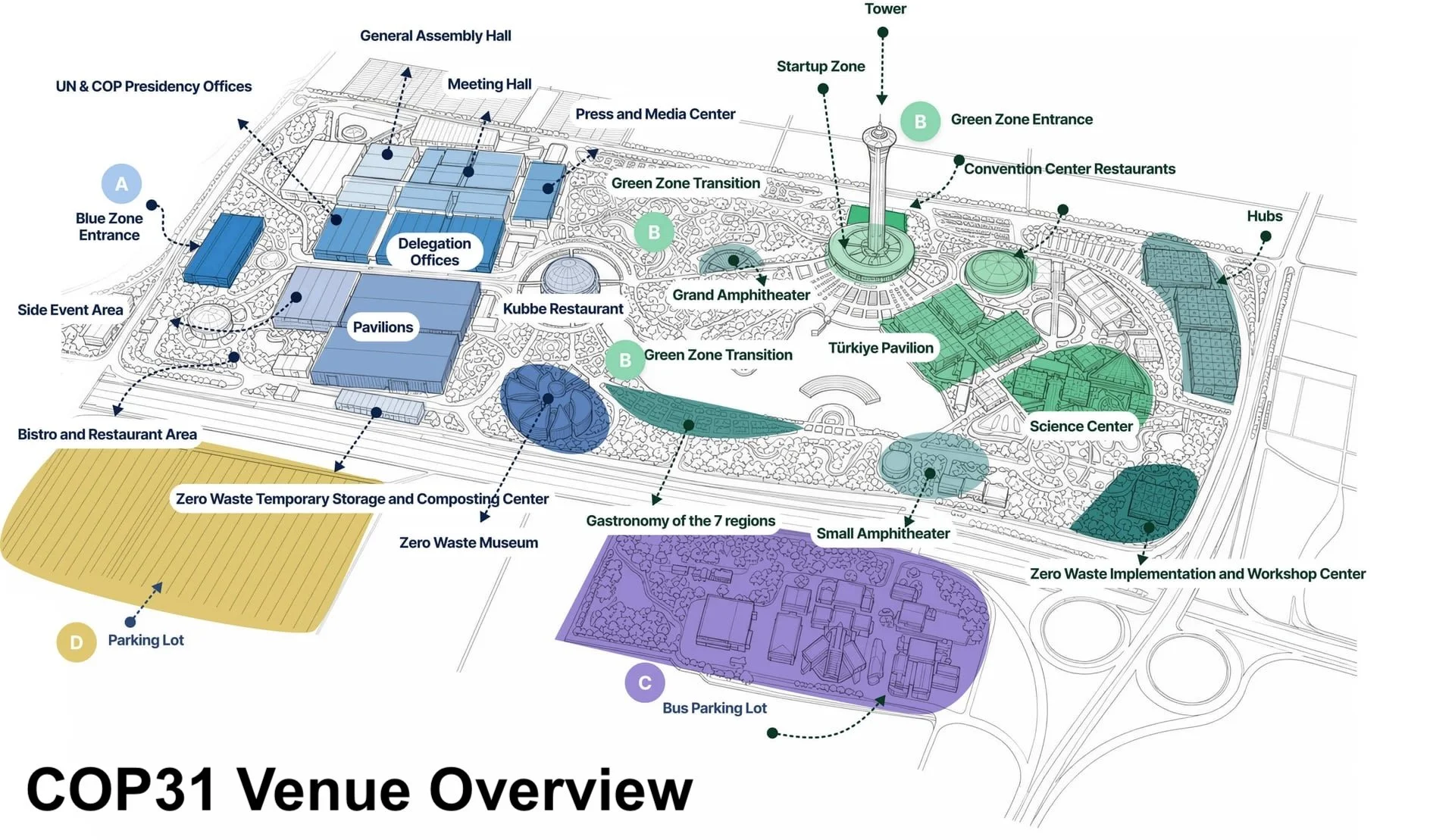
The blue zone pavilion space is what most people mean when they refer to COPs. Pavilions can be organized by any type of institution — countries, trading blocs, MDBs, specific industries, target topics (the Methane Pledge), NGOs, universities, and so on. We now see hundreds of pavilions in place. Location is competitive, and real estate is limited by the type of institution (parties vs. non-parties) and pricing, especially size.
Some pavilions are more external-facing, delivering a scripted series of events, full-time onsite staff for briefings, even functioning as galleries and tourist or business development platforms. Some are more practical meeting spaces, designed as an extension of the negotiations space for national interests. Pavilions may not be active for the full COP term, and sometimes spaces are shared. Broadcasting and remote participation in pavilions became widespread after COVID but may be declining now, probably because of the increasingly high costs associated with managing remote access.
Water is important in the pavilion space, and often more accessible and directly addressable than in the negotiations zone. For instance, the Water for Climate Pavilion was launched in 2021 in Glasgow and is governed by a steering committee which is chaired by SIWI. The Water Pavilion has a public-facing events agenda and a committee process to select themes and particular events. The Water Pavilion also serves as a way to socialize members of the broader water community to understand and engage with the climate community. The organizational team for the pavilion may be a good resource as well.
The Resilience Hub, led by a small consortium of groups, is probably the most important single adaptation and resilience pavilion at the COP. Water is not necessarily a major emphasis in the Resilience Hub, but the adaptation and resilience connections in this pavilion are often both level and deep.
Also in the blue zone will be some special coalitions, often mixing civil society, multilateral institutions, and party members. For instance, in Dubai, the Freshwater Challenge was launched. Many of these announcements — especially those from host countries — have short lifetimes and may not be well structured as they sit outside of the negotiations process or formal instruments like the MPGCA/GCA.
The Freshwater Challenge is led by WWF and falls into this gray zone, primarily because the linkage to climate issues is so vague and disconnected from other climate topics. Other coalitions include the Global Forest Coalition and Fair Water Footprints. A coalition may be a useful strategy for WASH investment and action, with a well-designed set of targets, issues, and goals.
COP29 in Azerbaijan saw the launch of the Baku Declaration on Water for Climate and the related Baku Dialogue, which is intended to support a coherent water agenda from COP to COP. However, the Dialogue is dependent on each new COP President supporting it, which may or may not align with each President’s priorities. There will be a Baku Dialogue at COP31, for example, but it’s unclear if it will be maintained in coming years due to a lack of Presidency support.
Separate office space for specific institutions is also a part of the COP geography. Most countries have a back office in the blue zone for private meetings. These are invitation-only. Some wealthier multilaterals and NGOs will also acquire office space.
The blue zone also has official side event space, and these events are often live-streamed. These are application-only and competitive but open to all accredited participants.
Lastly, the blue zone has food carts, a dining area, and service zones, such as a post office, ATMs, lost and found, media center, and help desk.
The green zone has been increasingly variable in size and focus. The green zone does not require accreditation and may actively invite the host country’s public for special exhibitions. Pavilions are a relatively new part of the green zone, and COP28 Dubai’s space was well organized and gigantic but less well attended than the blue zone. Major corporations tend to dominate the green zone, which is much smaller and more marginal (physically and in priority) than the blue zone. Little information has been available for COP31. Generally, most individuals tend to remain in either the green or blue zone. It is quite easy to find people in the green zone utterly unaware of any processes or developments in the blue zone.
The COP can also have important events beyond the blue and green zones. Bloomberg, for instance, has been organizing a media center event for a number of years in other spaces. The New York Times has done so as well.
Issues & Outcomes
It is a natural question to ask for groups that are focused on water issues at a climate policy: where are the entry points? Water has occasionally been a presidency priority. What is more common is that water is indirectly relevant to many existing priorities but key parties for finance, implementation, and policy may not see or appreciate fully the linkages that are important. Making these connections explicit is a useful strategy for the COP. In many cases, the preparation and legwork can be completed in advance of COP by reaching out to partners (or potential partners) to set up meetings and find events that are relevant and useful. Given that COP31 will have a much more limited set of remote access options, preparation is especially important.
There are perhaps three broad strategies for engagement at COP:
Negotiations
The negotiations are highly specialized with high transaction costs. They are important in terms of their global import and potentially in terms of their relevance to SDG6 and connecting climate finance with water sector investments, but actively following or trying to influence the negotiations is difficult. Having key partners can be useful for specific topics, such as climate finance targets, the Global Goal on Adaptation (GGA), and implementation issues for NDCs and NAPs as a whole (rather than for specific countries). Groups like AGWA, WaterAid, and SWA can be important allies for engaging with negotiations through proxies.
The GGA, for instance, is still in active development, and there may be points during COP31 in which negotiators or close advisors to negotiations need specific support on water- and WASH-related topics. These relationships are best cultivated before COP — parties will arrive at COPs with their strategy and plan agreed on by their home governments, leaving little room for last-minute influence once on site.
Alignment, Funding, and Partnerships
More than 190 countries are signatories to the Paris Agreement, including both donor and aid recipient countries, while multilaterals, foundations, adaptation funds (the GCF and GEF), corporations, and increasingly investors are also involved directly and indirectly in COP processes. The process of alignment and coalition forming is a primary intent for these groups, and speaking in and attending official side events and pavilion events is a good mechanism for identifying new partners.
The high concentration of connections at COP is useful to assemble or connect with new and existing partners, especially over the first seven to eight days. Intelligence and situational awareness are also key outcomes — information about specific initiatives or new priorities is a major benefit. Many of these groups will have their own pavilions, often with mid-level or senior staff. Deals are more likely to be settled in the blue zone, with most green zone events more public-facing. In either case, climate issues should be the center of these conversations rather than more traditional work.
NDCs and NAPs
Country-scale climate policy instruments are increasingly becoming a platform for a wide variety of public, civil society, and private sector/investor actors. NDCs are national determined contributions, a key outcome of the 2015 Paris Agreement. They are priorities for national and subnational climate commitments, designed to be implemented over a five year period. COP30 saw the launch of the second generation of NDCs. NAPs or national adaptation plans are older policy instruments, designed to list project and programmatic priorities for funding and implementation. They can be updated and adjusted on any cycle that a party chooses. When they launched after COP15 in 2009, they were originally limited to LDCs and focused on highly concessional funding and finance. However, they have expanded in scope and can advertise that projects have alignment with national climate goals for climate finance institutions and investors. About 80 countries now have NAPs, including many middle income countries. Especially for COP31, direct programmatic linkages to NDCs and NAPs should be a place for negotiating how an enterprise can connect with, support, or ask for support with national climate investments and priorities.
Resources & Further Reading
UNFCCC Information for COP31 Participants: https://unfccc.int/cop31/ifp
COP31 Side Events YouTube livestreaming link: https://www.youtube.com/playlist?list=PLEM21lCpB5Mc
Earth Negotiations Bulletin: https://enb.iisd.org/antalya-un-climate-change-conference-cop31
NAP Global Network: https://napglobalnetwork.org/
NDC Partnership: https://ndcpartnership.org/
Climate Policy Info Hub: https://www.climatewatchdata.org/
OECD’s Climate Resilience Policy Database: https://www.oecd.org/environment/cc/climate-resilience/
UNFCCC Biennial Transparency Reports: https://unfccc.int/biennial-transparency-reports
The Notre Dame Global Adaptation Initiative: https://gain.nd.edu/our-work/country-index/
Climate Action Tracker: https://climateactiontracker.org
The World Bank’s Country Climate Development Reports (CCDRs): https://www.worldbank.org/en/publication/country-climate-development-reports
The Climate Change Performance Index: https://ccpi.org
The EU’s resilience dashboards and indicators: https://commission.europa.eu/strategy-and-policy/strategic-foresight/2020-strategic-foresight-report/resilience-dashboards