Finding Purpose in Water: Meet Lilian Lunyolo
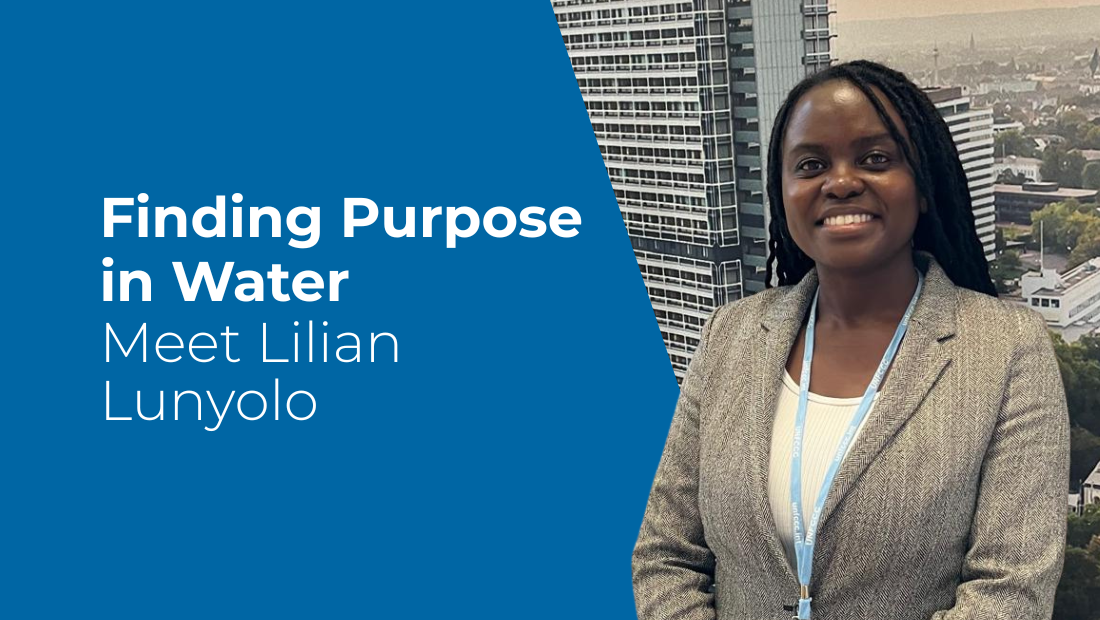
A self-proclaimed ‘mistake’ put Lilian Daphine Lunyolo on a path that has taken her around the world and helped her contribute to water and climate discourse in her home country of Uganda. An elective course on water as part of her second- choice degree - environmental sciences - quickly led to an internship working on climate-sensitive water stewardship projects under the German Development Cooperation in Uganda. Lilian saw the internship as a productive way of filling time until she found a “real job”.
In 2025, many real jobs later, AGWA was honoured to welcome Lilian as its youngest ever board member. Since joining she has helped develop a global mentorship programme AGWA plans to launch soon with Josh’s Water Jobs.
We spoke to Lilian about how she got into water, what she looks forward to sharing with her board members, and key observations about the water sector across various contexts.
Lilian’s journey into the water sector
Lilian views her entry into the water sector on one hand as an "academic mistake”, and on the other, a divine orchestration, especially in retrospect. A missed shot at medicine landed her at Makerere University studying environmental science, where a water module caught her attention while she wrote a thesis on how urbanisation shapes water quality in her hometown. In time, the healthcare sector's loss of a potential radiographer proved to be an invaluable gain for the global climate-water community.
A friend's recommendation two months before her undergraduate graduation led to an internship offer with GIZ that Lilian initially viewed with skepticism, holding out for something more long-term, a real job as she called it. However, after encouragement from family and friends, she relented, took the interview, impressed the panel, and accepted the position. What followed was six months of working alongside Uganda's Ministry of Water and Environment, a further year as a consultant, and, by her own account, falling "madly in love with water."
After that initial work experience, a DAAD scholarship took her to the Cologne University of Applied Sciences for a master's in water resources management. Following her graduation, the Carlo Schmid Programme brought her to the World Food Programme in Timor-Leste where she could contrast her Ugandan professional experience on water and climate issues. She later returned to Uganda for a year at the Austrian Embassy in Kampala, where she deepened her understanding of how development cooperation in the water sector actually functions. With that solid national experience, she advanced to the global level through a fellowship jointly hosted by the United Nations University and the UNFCCC Secretariat in Bonn. Here, she eventually led a team coordinating water-climate engagements within the UNFCCC process, ultimately coordinating the organisation's representation at the UN 2023 Water Conference.
How Lilian became involved with AGWA
AGWA's deputy executive director, Ingrid Timboe crossed Lilian's path in 2023, when Ingrid was working with the COP 28 Presidency in the UAE to develop a water action pledge and needed institutional grounding for the initiative at the UNFCCC. Lilian's team took on the correspondence and helped connect Ingrid's work on water to a colleague coordinating a climate-resilient food systems alliance at the Secretariat. A reunion with Ingrid at the Bonn Climate Conference in June 2025 rekindled the relationship and, ultimately, prompted Lilian's application to join the board.
To the board, Lilian brings unique experience from working across developing and developed country contexts, including work in refugee-hosting settings and two development cooperation agencies. Now in academia as a Research Associate with the Water Innovations for a Sustainable Earth Group at Arizona State Universityher research examines how global climate governance translates into water-centric actions at the national level.
Her place on the board also sends a signal in itself: "My position on AGWA's board is a landmark achievement that others can learn from or emulate. It offers a meaningful avenue for harnessing the potential of young people in shaping work that is inter- and cross-generationally relevant." She hopes to contribute to developing a mentorship program that enables young professionals to accelerate their careers in the water-climate sector.
From National to Global Water-Climate Action
Lilian believes that the urgency for water-centric climate action is not abstract; rather, it is highly critical and contextual. Across all four contexts in which she has worked, water is central to climate action and sustainable development, but its function differs.
For instance, in Uganda, a country that has had several decades to develop national institutions and sectoral systems since its independence, water action is closely tied to development, livelihoods and the strengthening of established institutions. In Timor-Leste, a comparatively young nation still consolidating its institutions and transitioning from humanitarian assistance to long-term development, water action is more protective and foundational. It reflects the country’s significant climate vulnerability and broader state-building priorities.
At the UNFCCC, the focus shifts from implementation within a particular country to building shared frameworks, raising the political visibility of water and identifying principles that can accommodate widely differing national circumstances while advancing climate-resilient development. In academia, her task now is to generate evidence that helps governments, practitioners and policymakers understand how multilateral climate processes such as the UNFCCC can be leveraged to advance water-centric climate action.