
From Early Warning Systems To More Advanced Warning Systems

AI generated image (ChatGPT), inspired by Tolkien’s Lord of the Rings*, 2026
At the Brussels Climate Chance Europe 2026 Summit plenary on digital, AI, and resilience, I landed with this question: what are the main data-related challenges in early warning systems? It is a fair and relevant question, especially when linked to AI. Data quality, access, interoperability matter. But, the question shaped the scope. The water footprint of AI infrastructure, the energy demands of data centers, how they sit within broader water resilience strategy, constitute a parallel strand. And this is where AGWA has been working, which would also have been an interesting story,
What follows is my response, very similar to how I read it out in the forum. I am reprinting this not as a highlight, but efficiently, as material worth reshaping into essay form. A forum response and an essay are different animals. One is spoken under time constraint. The other is written for reflection.
The real stress point in early warning is not in better data or faster forecasts. It is in the decision pipeline itself. Consider what happens when a warning arrives. Most countries have the forecast. What they often lack is agreement on what comes next. Who calls whom. Who opens the budget. Who tells the farmers. Who decides the evacuation. These are choreography problems.
Many countries are now developing multi-hazard systems that integrate across data silos. These are real advances. But even as integration improves, the bottleneck remains the same: translating forecasts into decided action, across institutional boundaries, with feedback that closes the loop. The data gets better. The decision architecture does not. Here is where AI becomes useful: it can connect siloed data streams into shared decision frameworks, help translate a signal into a clear threshold, that threshold into a named decision someone owns, that decision into a message that reaches the person who can act.
But the deeper issue sits at the discipline level. We built water management on statistics: the science of how systems stand still. Climate change demands kinetics: how systems move. The two worry about different things. Statistics concentrates uncertainty on rare events. Kinetics concentrates it on the future, where decisions happen now. Our forward models often still rest on historical assumptions. We build for flows we have measured, then assume demand and institutions behave as always. That assumption has stopped being reliable.
The global hydropower fleet proves the point. Dams built decades ago for historical records now run at half capacity. China and Brazil sit under 50%. India and the US below a third. In 2023, global hydropower output had its biggest annual decline in nearly sixty years. The infrastructure has not failed. The future moved faster than the assumptions underlying the design. (Hydropower Is Getting Less Reliable as the World Needs More Energy, New York Times, November 2025)
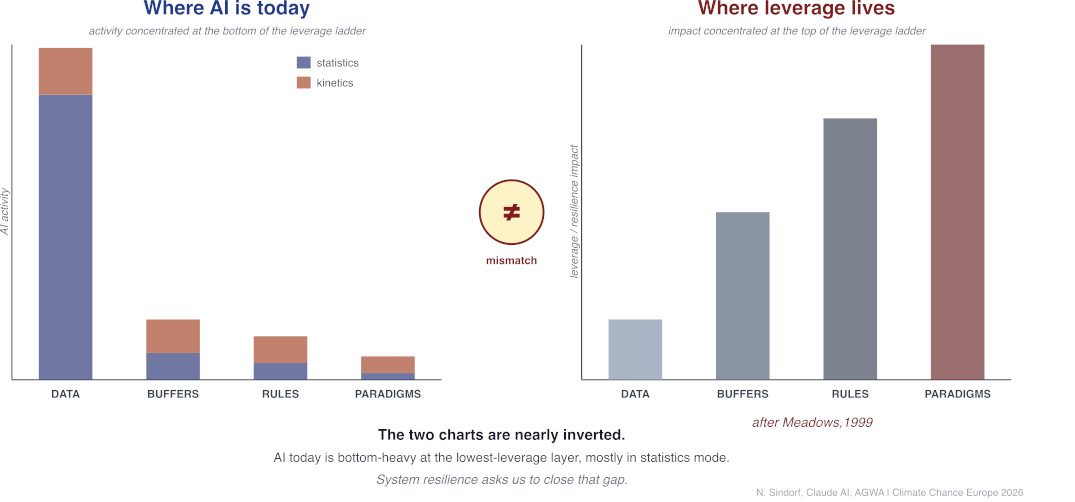
This shift from statistics to kinetics is the mismatch, as depicted in the above graph. Decision Making under Deep Uncertainty (DMDU) research addresses it: how do you decide when you cannot fully predict the future? How do you build resilience when the historical record is no longer a guide? AI helps here. It benchmarks competing uncertainties, surfaces where assumptions are most fragile, enables dynamic learning over snapshots.
The highest-leverage places to act in any system sit upstream of the warning data itself: in how the rules are set, the buffers that keep it stable, the paradigms that decide what we measure. Meadows understood this. Data is necessary. But it has never been sufficient to progress towards systemic resilience.
Yet, AI is not the single solution. It is a tool for the response chain. A system with multiple decision pathways, with people who have authority and buffer to act under pressure, with feedback that closes the loop from response back to learning, is a system AI can sharpen. Not replace. As is often the case in this field, early warning was never meant to be only about data. What makes a warning system truly advanced is not better forecasts, but a decision pipeline where someone acts and learns.
Nikolai Sindorf
Brussels, Belgium
*Tolkien's beacon system in Return of the King proves the point. The signal travelled fine. The system failed because those with authority to act chose not to light them. Even when lit, riding to aid required prior agreement. The technology was never the constraint. Who decides to act, and whether they have agreed in advance, determined success. Warning systems are decision systems, not just signal systems.
Enjoy reading essays like this? Please subscribe to the AGWA family of newsletters! You can join AGWA and subscribe here.