
From Reaction to Resilience: Aligning Water and Energy Policy for the Data Center Boom
by Josh Weinberg and Georgette Mrakadeh-Keane
Experts have been touting the need for integrated water-energy management for decades. The emergence of data centers, and now explosive demand for more energy intensive facilities that can meet requirements for AI processing, make it an obvious priority. Singular water and energy strategies for data centers may not be enough or prone to risk of disruption—even if they include investment in water efficient cooling and water replenishment programs.
The bottleneck for building data centers is not capital. What is actually holding development back is the availability of energy, water, labor and communities willing to provide the land and infrastructure for them to connect to.
It’s hard to say when—if ever—the appetite for investment in building out AI infrastructure will reach its ceiling. Market analysts are divided on whether the current surge in capital expenditure is a rational bet on tangible future demand for AI services, or an act of collective faith driven by a speculative 'build it and they will come' mentality. This echoes the late-1990s telecom boom, where companies funded vast networks of global fiber-optic cable under the assumption that internet adoption would inevitably catch up to the massive oversupply of bandwidth.
The impact that the first wave of data center expansion has had on local energy grids and water sources has led to high levels of public attention and outcry. The capacity to provide land, water and energy while providing net benefits to local populations could—and should—be the market advantage that attracts new developments. This needs to be sold to both the operators that will build the data centers and the communities that will host them. Ensuring the economic benefits fully reach those communities, rather than just passing through them, requires dedicated actions and coordination across a wide range of actors.
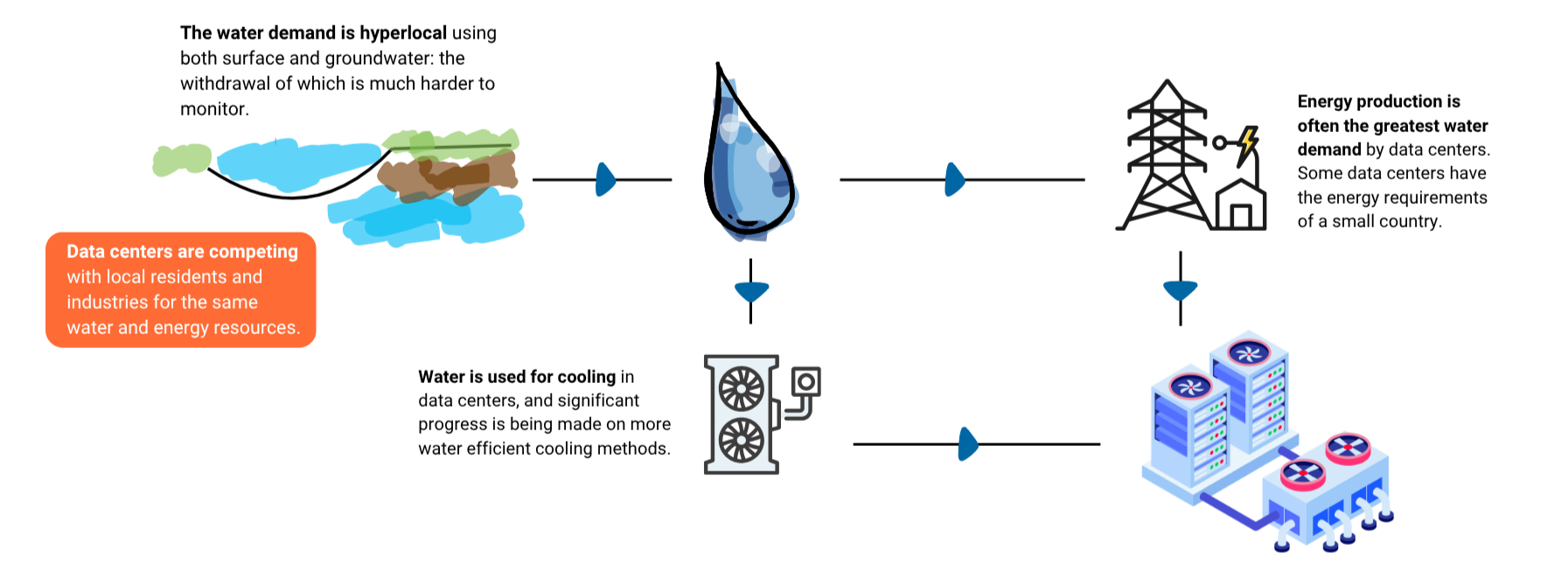
Digital Infrastructure Energy Challenge Is Its Biggest Water Issue
Over the next five years, more than half of all new data center development—and up to 90% of new computer output—will be driven by AI training and inference. AI demands denser housing of servers, storage systems and networking equipment, while utilizing thinner chips than traditional cloud computing centers in order to process more data concurrently. This requires significantly more electricity. These high-density racks of IT equipment also require liquid cooling, which can be achieved with lower water consumption when the best available technological solutions are applied.
Crucially, the energy mix used to meet this demand will determine the ultimate water requirements and climate impacts. Most power generation requires significant amounts of water, withdrawn from the same regional sources as the data centers themselves. The International Energy Agency (IEA) report Energy and AI (2026) projects that the electricity supplied from coal, natural gas, and nuclear power to run AI data centers will increase nearly 100%—from 320 TWh to 630 TWh—accounting for 60% of total electricity use in the data center sector which would reach more than 1200 TWh by 2035. (This is the ‘base-case.’ In higher-growth scenarios, the total would be 30% higher). All of these thermal generation methods require significant water resources for cooling, alongside upstream water use in fossil fuel extraction. While many data center operators and governments are investing heavily in solar and wind power to contribute to the electric grid as low-carbon, low-water alternatives, water-intensive forms of energy generation will grow to meet this new demand.
Data centers are not the only driver of global grid expansion. They are part of a massive surge in demand alongside electric vehicles, space cooling, and heavy industry (including green hydrogen). Some argue this broader context means concerns over data center water and energy demands are overstated, driven by the sheer speed of their construction and general societal anxiety surrounding AI. Others note that more attention should be paid to the opportunities data centers and AI can play in contributing to energy grids through smarter and circular designs. The critical takeaway, however, is that energy planners and developers must understand exactly where digital infrastructure fits within the broader water-energy landscape as they work to meet growing demand across sectors. Otherwise, they will face risks of severe operational disruptions, particularly during periods of competing peak demands.
Mitigating Risk Through Integrated Planning
Singular water and energy strategies for data centers may not be enough, or prone to risk of disruption. For example, space cooling in buildings follows the same seasonal and time-of-day demand peaks as data centers and thermal energy plants—peaks which often coincide with periods of lower water availability. In places like California, policy proposals have been put forward that would require data center operators to report both direct water use and the indirect water footprint of their energy consumption. Reporting requirements serve as a critical trigger for accountability and better siting processes. This should be driven by more than transparency concerns. Integration of water and energy planning is necessary to mitigate disruption risks for both the data centers and the local ratepayers.
With the current boom in massive AI training hyper-scaled facilities, their sheer scale can require the sort of integrated water and energy planning and development on par with a small country. This can transform remote areas with large low-carbon energy generation potential but extremely low latency into frontiers of new economic potential—in places like Sweden, Canada or areas of Brazil situated near hydropower plants. In places where the scale of what is being planned is extraordinary in size, like the proposed AI training facilities in Utah and Ohio with 9–10 GW each if maximum capacity is reached (for perspective, 9 GW to power a single facility is more than double the state of Utah’s current total electricity consumption), the water implications of the energy mix are a critical factor in their long-term feasibility. Ultimately, regulation to ensure the availability of water to meet the specific energy requirements of both the data center and other users must be assured. This may fall on local energy authorities but must be coordinated through national and state level policies and incentives for digital infrastructure, together with water management plans that are currently often made at the local or basin level.
The hardware supply chain faces similar challenges. The majority of semiconductor production is highly concentrated in a handful of places (China, Taiwan, Korea, Japan and the United States) with more than 30% of facilities located in regions experiencing severe water stress and competition (GWI & Xylem, 2026). Water demands in this industry are projected to increase by as much as 600%, ultimately accounting for 40% of the direct water demand required by digital infrastructure. This surge is driven by the fact that semiconductor fabrication requires ultrapure water, a process that consumes four times the amount of standard municipal water to produce.

As manufacturing pivots to advanced chips that are capable of handling AI workloads, both the water and energy intensity of production continue to rise. This poses a major risk in key global hubs. In Taiwan, for example, semiconductor fabrication plans account for roughly 15% of industrial water use and 10% of national energy consumption. Similar pressures exist in mature markets like South Korea, and in rapidly growing emerging markets like Vietnam. Because these demands are notoriously difficult to engineer away, national and regional planning must proactively accommodate these constraints to avoid major supply chain disruptions.
Moving from Reaction to Resilience
As countries develop national policies for AI and digital infrastructure, they must embed mandates for energy and water security directly into their frameworks. The past two years have seen a massive influx of reactive policies to manage the strain, including construction moratoriums in Johor, Malaysia, permit delays in Ireland and calls for new digital infrastructure legislation in the US and Germany.
While reactive policies are a necessary course correction following extreme geographic concentration, the goal must be proactive, integrated planning. South Korea has shown one version of what this looks like: national policies that actively steer developers toward regions already assessed to have the energy and water capacity to absorb them. Without such frameworks, regions will blindly compete to attract industrial investment, resulting in developments where energy generation comes at immense costs to carbon emissions and local watersheds.
India is beginning to push for better integration between energy, water and digital policies as it grapples with this challenge. The Ministry of Electronics and Information Technology’s recent 3-point AI agenda to support the ‘IndiaAI Mission’ enforces explicit mandates for local server manufacturing alongside strict energy efficiency and water sustainability requirements. This includes groundwater abstraction restrictions and mandates for advanced, water-saving direct-to-chip cooling architectures.
Water sustainability measures for direct water use of data centers will not ensure resilience on their own—they must also be integrated across national energy policy plans.
Electricity demand is rising on many fronts. National and local authorities must understand how the energy choices made today will determine what water resources look like in these regions for decades to come. Social and regulatory systems naturally adapt slower than physical ones, but the unprecedented speed of AI data center development is severely compressing the timeline for government response. Countries around the world must close the gap between energy, water and digital infrastructure planning processes.
This article is published as part of a project between the Australian Water Partnership (AWP) and the Alliance for Global Water Adaptation (AGWA) which seeks to equip cities and regions in the Indo-Pacific with the policy frameworks, knowledge, and tools they need to not just survive an AI boom but thrive in it. Read more about the project >
For Water Utilites: Unpacking confusion, contention, concern and conflicting narratives on data center and water risks >
An overview of the landscape: Charting a water and energy resilient future for digital infrastructure in the Indo-Pacific >