
How much water do data centers really need?
Data centers are essential, profitable infrastructure for the modern world. AI is accelerating their expansion, but they have long been built to store everything from highly-sensitive data to deleted emails. Yet they are not natural – or welcomed – additions to communities, namely because they are not seen to benefit their local area.
While initial infrastructure construction brings jobs, once built they primarily contribute as a consumer and customer – by paying for energy, water and land resources used to public authorities or private vendors and by paying taxes. Additional investment in a data center once built is focused on apparatus like semiconductor chips, built thousands of miles away. From a local perspective, benefiting from a data center requires – existing – sufficient capacity to sell electricity and water services to keep the centers running without compromising the local environment or affordability of services for residents and other users. Otherwise the presence of a data center has a wholly negative impact on its local environment.
Data centers need water. But there are conflicting narratives on exactly how much water is needed, and what the appropriate levels of concern and responses to that demand should be. There has been great enough concern raised that some tech leaders, such as OpenAI CEO Sam Altman, have resorted to calling increased water risks posed by data center energy and water demands as a ‘fake’ story when asked during a recent tech summit in India. Altman also stresses that energy is a larger concern than water. This statement ignores the fact that most local energy production also needs water, for cooling. The point of contention is the calculation behind the water footprint of single AI search, information presented to inform the public of the unseen resource requirements of their behaviour beyond the keyboard.
While the methodology to arrive at an exact liters per search metric is debated, the argument misses the central point: data centers are large local water users where they are located, as are the facilities needed to produce the semi-conductors and hardware.
The availability of technology solutions – to reduce water use, increase reuse or use alternative water sources for cooling – is a critical point that can enable sustainable, water-resilient development of data centers. That potential must be translated into investment and operations to enable water resilience. It requires commitment, capacity and capital to come together from a wide set of stakeholders, from data center developers to national and municipal governments, local utilities, shareholders and investors.
High-tech industries are well positioned to provide the investments needed to improve water efficiency or improve environmental health in other ways across a watershed. This includes supporting applications of AI to improve water efficiency, reduce leakages and improve services to help contribute to sustainable management of water resources in areas with data centers. Investment in water resilience is investment in business resilience: because if taps run dry, so does business.
Planning and strategies for water resilience requires:
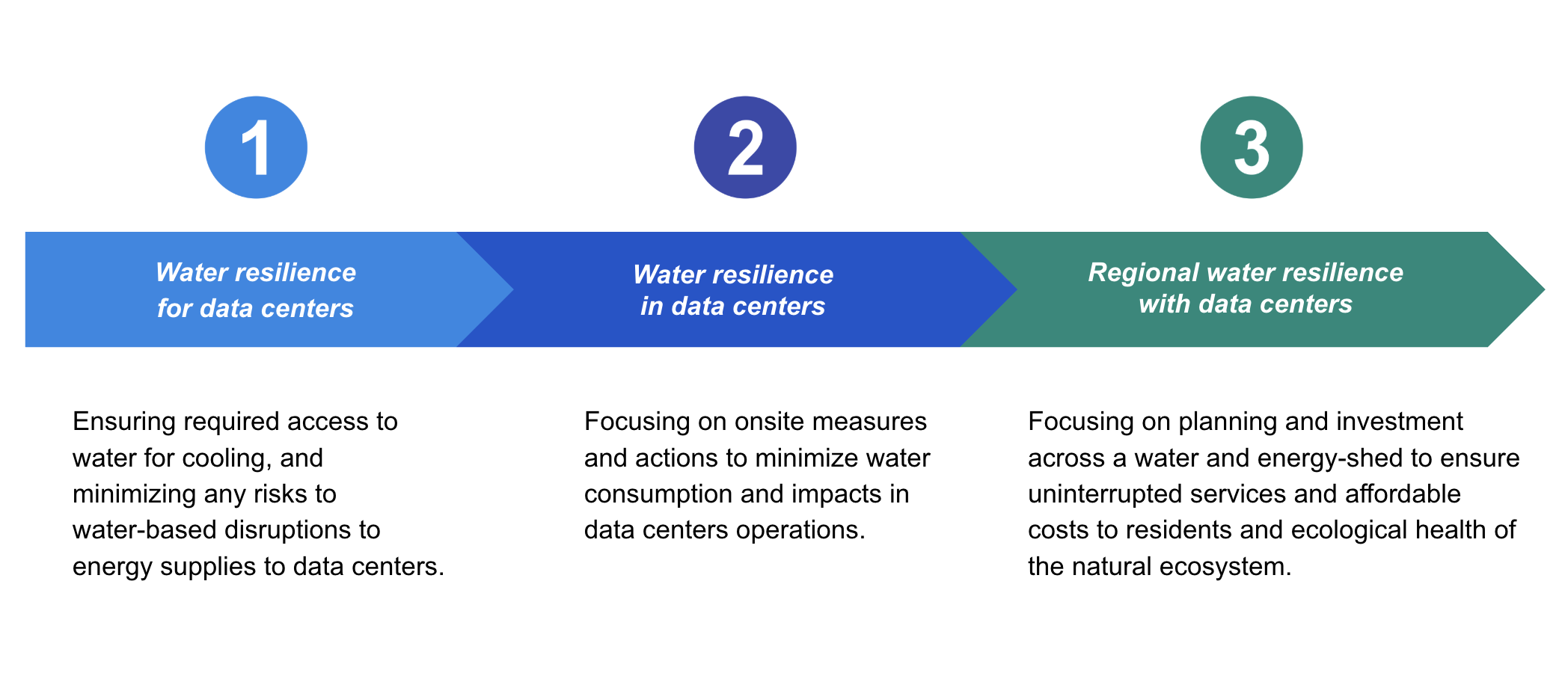
The natural progression for a data center operator is from one to three: understanding the risks, taking direct actions to reduce water risks for operations; engaging in wider basin level action. This is standard stewardship practice but to achieve the best results, the planning process would move from three to one – or at least in parallel. Planning and coordination between stakeholders would focus on moving from regional water resilience strategies that promote measures to support actions for water optimization in data centers to ensure that their water use comes with low risk to other users and the environment.
AGWA is working with the Australian Water Partnership on a project that aims to bring together relevant stakeholders to discuss how to ensure a water and energy resilient future for digital infrastructure. While the project is focused on the emerging data center market in the Indo-Pacific region, we hope it will provide valuable guidance for countries and communities around the world.
To get an overview of the many moving parts of water in a rapidly accelerating AI boom, read our articles:
Unpacking confusion, contention, concern and conflicting narratives on data center and water risks
Charting a water and energy resilient future for digital infrastructure in the Indo-Pacific