Reality check in the desert
While much global attention has (understandably) been focused on the unprecedented drought and wildfires in Europe, in my little corner of the world, this summer’s climate news has been dominated by the long-anticipated arrival of a water crisis on the Colorado River. Internationally, the Colorado has been held up as both an example of promising transboundary water cooperation, while at the same time serving as a cautionary tale about the limits of relying on past hydrology to predict and plan for the future.
That future has now arrived for the more than 40 million people in Mexico and the United States who depend upon the river for drinking water, recreation, economic activity, hydropower, agricultural production, and, in the case of the 30 federally recognized Tribal Nations in the region, cultural survival. Over the past 20 years, the river’s annual streamflow has been reduced by roughly 20% due to increased evaporation, reduced snowpack, and declining groundwater consistent with higher temperatures linked to climate change. Simultaneously, the region’s population has increased by roughly 25%, and several basin states remain among the fastest growing in the United States. Millions of people – including my own family – have been drawn to the American Southwest due in no small part to its amazing natural beauty, including the magnificent Colorado River.
Major agricultural operations in both the U.S. and Mexico are heavily dependent on the River, utilizing up to 85% of the annual supply, the majority of which is used to grow feed for livestock. Last winter’s snowpack was the lowest in recorded history, which came on top of ongoing aridification. Now the basin’s two main reservoirs for water storage – Lakes Powell and Mead – have hit historic lows and are flirting with dead pool: the point at which water can no longer be drawn downstream by gravity, and hydropower can no longer be generated.
None of this comes as a surprise. Scientists, water managers, and Tribal authorities have been sounding the alarm on the Colorado for decades. The Law of the River, which governs water sharing between the upper and lower basin states, is based on a volumetric accounting of water which simply has not existed in the basin for a century, if not longer. And while this structural deficit has been known decades, folks in the basin could pretty much go on with business as usual because the American Southwest was relatively sparsely populated and neither the upper nor lower basins needed to draw upon their full allotment.
Fast forward to 2025 with aridification in full effect, a growing population, and a booming regional economy, the Colorado can no longer support the status quo. Drought restrictions are in place in all seven states, and major cities like Las Vegas and Los Angeles have successfully decoupled population growth from water use. But these are, at best, marginal fixes that do not address the underlying water imbalance and climate challenges.
As the states battle over permanent water use reductions, the U.S. federal government finally waded into the fray, proposing severe cuts that fall disproportionately on the lower basin states (Arizona, California, and Nevada) as part of its Final Environmental Impact Statement for future Colorado River dam operations. The states will almost certainly end up back in litigation, although most have publicly stated that they would prefer to sort it out amongst themselves rather than take a gamble on the courts. Despite this apparent willingness, compromise remains elusive.
Meanwhile, the Native American Tribal Nations, who continue to be sidelined in the negotiations despite having legal claim to over 20% of the River’s water, have created intertribal water conservation partnerships, an Indigenous water leadership academy, and are leading the charge to redefine water governance in the basin utilizing both Indigenous and western management practices. Nature-based solutions like beaver reintroduction and managed aquifer recharge are being piloted to help increase infiltration and boost water storage. Drip irrigation and crop substitution, rotation, and dryland farming techniques are being expanded on farms that once relied upon flood irrigation.
But there are limits to what these solutions can accomplish on their own. It is estimated that annual cuts of 3-4 million acre feet (3.7-4.9 km3) are needed to stabilize the Colorado River system. That’s roughly half the total annual paper allocation for the lower basin, including Mexico. A reduction of this size is possible only through drastic cuts to irrigated agriculture in both the upper and lower basins, as well as major investments in wastewater reuse, desalination, and storage. It is true that these interventions will be expensive, but the longer we wait, the harder – and more expensive – they will become.
A final note on the discourse. As the states and federal government grapple with these challenges, I have detected a worrying and not-so-subtle change in narrative from key decision makers in the basin. This narrative seeks shift the blame for the unfolding crisis onto “Mother Nature,” as if humans had no hand in bringing us to this point. This is an incredibly infuriating and dangerous assertion. Not only is it untrue, but it also constrains the responses that we can take, turning humans into passive victims, instead of active participants in shaping and reshaping the ecosystems around us.
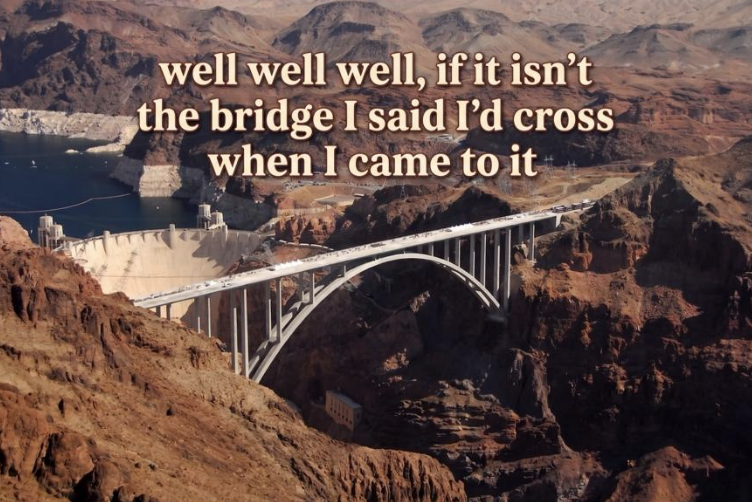
One thing is for certain: it didn’t have to be this way. The Colorado River continues to serve as a real-time case study in managing tradeoffs and building water resilience under the new normals of climate change. By delaying these critical decisions and failing to address the underlying causes, including our greenhouse gas emissions, politicians, water managers and the U.S. federal government have only made the transition more challenging for the 40 million people who must now cross the bridge into their new hydrological reality. There is no going back. It is still possible to build a beautiful future on the other side, but first we must accept the new math of the Colorado River and work together to ensure a sustainable future for all its inhabitants.
Ingrid Timboe
Portland, Oregon
Enjoy reading essays like this? Please subscribe to the AGWA family of newsletters! You can join AGWA and subscribe here.