Rethinking Water Resilience for an Uncertain Future: Key Messaging for the 2026 UN Water Conference
Key messaging to strengthen resilient water governance discussions and outcomes across the UN Water Conference’s six Interactive Dialogues
We have reached a pivotal moment for global water governance. As the 2030 Agenda draws to a close, Member States and international water leaders will gather in Abu Dhabi next month seeking to learn from the successes — and limitations — of SDG 6 and build a stronger, fit-for-purpose global framework for water governance.
So, what does global water governance look like in the post-2030 era? The past is no longer a reliable guide to the future. Building water resilience requires new approaches to planning, investing, and decision-making. As multilateralism itself comes under increasing pressure, how can we build a robust governance framework that truly works for water?
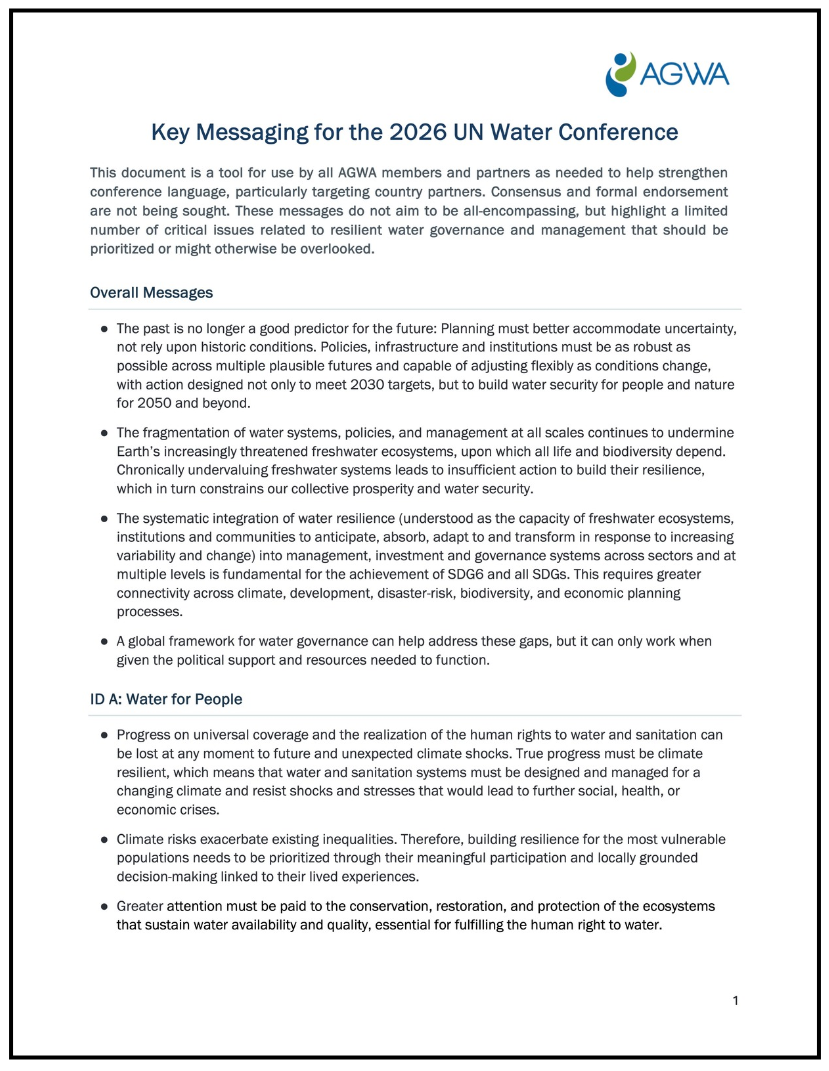
That’s the underlying premise of AGWA’s Key Messaging for the 2026 UN Water Conference, the outcome of a crowdsourced effort within the AGWA network to help its members and partners bring water resilience into discussions and engagement with Member States and partners during the upcoming 2026 UN Water Conference.
Fragmented approaches to governing and managing water undermine the resilience of water systems and the freshwater ecosystems they support. At the same time, the chronic undervaluing of these systems limits investment in their resilience, putting water security and our broader economic and social well-being at risk.
Building water resilience means bringing water into decisions about climate, development, disaster risk, biodiversity, and economic planning. It also means looking beyond individual projects to build resilience across entire water systems, including the ecosystems, communities, and institutions that rely on them.
The messages cover the conference’s six Interactive Dialogues:
Water for People
Water for Prosperity (Including Food Systems)
Water for Planet
Water for Cooperation
Water in Multilateral Processes
Water Investments
The messages aren’t intended to be comprehensive or to seek formal consensus or endorsement. Instead, they highlight some of the issues that need greater attention and help frame the broader conversation about what it will take to build water resilience in an increasingly uncertain future.
The content of this material has not been reviewed and approved by the United Nations and does not necessarily reflect the views of the United Nations or its officials.