
Water Reveals the Limits of Sustainable Finance Taxonomies
Guest article by Bapon Fakhruddin¹ ² ³ & Kristina Anguelova¹ ⁴
¹ AsiaGlobal Fellow, Asia Global Institute, The University of Hong Kong, HKSAR, China
² Board Member, Alliance for Global Water Adaptation (AGWA), USA
³ Climate Investment Principal, Green Climate Fund, Songdo, People’s Republic of Korea
⁴ Advisor, The Nature Conservancy, Republic of Singapore
Abstract
Sustainable finance taxonomies identify environmental eligibility, not investability, risk allocation or appropriate capital. Water security exposes these limits because essential services, ecosystem functions and commercial activities require different financing arrangements. This commentary distinguishes economic value, financial exposure and credible payment, using Cape Town’s catchment restoration and 2026 performance-based bond to illustrate their connections. It proposes a pathway from classification through preparation and capital allocation to verified resilience. Public expenditure and grants are legitimate destinations within that pathway, while commercial participation depends on credible obligations, capable institutions and equitable risk allocation.
Taxonomies and water security
Water security connects public goods, essential services, nature and commercially financeable activities. Its investment requirements span assets with identifiable customers and interventions whose benefits extend across communities, sectors and generations. These differences make water a revealing test of what sustainable finance classifications can accomplish, and where institutional and financial design must take over.
Taxonomies address a genuine information problem: shared criteria improve comparability and constrain weak environmental claims. However, adoption is not effective implementation. Comparative evidence documents voluntary frameworks, uneven disclosure and incompletely specified transition pathways. The relevant distinction is therefore not simply between jurisdictions with and without taxonomies, but between classification systems and arrangements that make their criteria operational ((Marchewitz et al., 2026; OECD, 2020). An aligned activity does not automatically have a creditworthy sponsor, affordable financing or a workable allocation of risk.
Adaptation makes context particularly important. An intervention’s contribution depends on hazards, exposure, vulnerability and intended beneficiaries; identical assets can have different resilience value in different locations. Credible eligibility requires a climate rationale, baseline conditions, safeguards and measurable outcomes (Green Climate Fund, 2025). This assessment establishes environmental relevance, not the capacity to deliver or repay. A taxonomy-aligned asset, a financing commitment and a realised resilience benefit should consequently be assessed separately. Their connection requires evidence across the investment lifecycle, rather than reliance on the label alone.
Water value and financial return
Flood protection, watershed restoration and rural sanitation can produce substantial collective benefits without revenues sufficient to repay private capital. Beneficiaries may be dispersed, exclusion impractical and charging inequitable. By contrast, efficiency upgrades, industrial reuse and established utilities may support commercial finance where tariffs, contracts, regulation and operations are reliable. These activities share environmental objectives but not investment characteristics (OECD, 2026).
The financing mix reflects this heterogeneity. Developing countries spend approximately US$164.6 billion annually on water, with about 91% from governments and state-owned enterprises and less than 2% from private sources. The World Bank (2024) separately estimates additional annual spending of US$131.4–140.8 billion for universal water supply and sanitation access. That narrower requirement should not be conflated with needs across all water resources and resilience functions. Public dominance is not, by itself, evidence of market failure; it also reflects public responsibilities and affordability constraints.
The wider adaptation gap reinforces the need to look beyond labelled assets. For 2035, United Nations Environment Programme (UNEP, 2025) estimates annual developing-country costs of US$310 billion through modelling and needs of US$365 billion through extrapolated national plans. These are different estimation methods, not a confidence interval. International public adaptation flows were US$26 billion in 2023. The figures differ in year and coverage and do not measure all adaptation expenditure or establish why particular projects remain unfunded.
From ecosystem value to credible payment
Three distinctions organise the financing problem. Natural systems first create economic value through water regulation, flood attenuation, recharge and ecosystem resilience. Avoided-loss, replacement-cost and productivity measures can make these benefits visible. Second, dependencies can create financial exposure: watershed degradation may increase a firm’s operating costs, interrupt production or impair assets, while a municipality may face additional infrastructure expenditure. Third, exposure does not itself establish an enforceable payment obligation.
Where external repayable finance is appropriate, some benefit must support credible payments from an actor able and willing to pay. Tariffs, availability payments, payments for ecosystem services, outcome payments and public expenditure offer different routes. Attribution, payer reliability and contractual terms matter as much as valuation. A savings estimate is not automatically an assignable cash flow, and financially material risk can exist without revenue. Where no equitable commercial payer exists, a public budget or grant can fund the intervention directly without manufacturing a commercial return.
Nature-related disclosure supports assessment, not payment creation. The Taskforce on Nature-related Financial Disclosures (TNFD, 2026) LEAP guidance moves from locating interfaces with nature to evaluating dependencies and impacts, assessing risks and opportunities, and preparing responses and disclosure. Its 2026 discussion paper, explicitly a consultation draft, addresses difficulties translating dependencies and impacts into risks and financial effects (TNFD, 2026). These tools can clarify materiality, but neither a disclosure nor a valuation identifies who must finance restoration. Water makes this broader nature-finance problem tractable because hydrological services can often be measured and connected to users or avoided infrastructure costs. Biodiversity benefits can be more diffuse across actors and time; the underlying distinction between value and payment still applies.
Cape Town: costs, outcomes and contracts
The Greater Cape Town Water Fund illustrates the transition from ecological function to a financing proposition. Its business case examined removing invasive alien vegetation from seven priority catchments to increase water availability. Restoration was analysed as ecological infrastructure and compared with engineered augmentation, rather than justified by assigning nature an intrinsic financial price (Stafford et al., 2018).
The 2018 analysis modelled approximately 50 million cubic metres of additional annual water within five years and about 100 million within 30 years, relative to business as usual. It estimated restoration at approximately one-tenth the full-cycle unit cost of alternative augmentation options, including groundwater, reuse and desalination. The comparison used discounted costs and water gains over 30 years with a 6% discount rate. These are ex ante estimates on a 2018 basis, not observed water gains or current prices. Unit cost is not a tariff, project revenue or investor return (Stafford et al., 2018).
Avoided expenditure can nevertheless support a financing case. Efficiency investments may be funded against predictable savings, while public infrastructure can receive availability payments instead of user revenues. Applying this logic to catchments requires demonstrable benefits, credible attribution and an institution capable of contracting and paying for them. Economic comparison informs that decision; it does not predetermine the financing instrument.
In 2026, FirstRand Bank issued the R2.5 billion Cape Water Performance-Based Bond, arranged by Rand Merchant Bank (RMB) and listed on the Johannesburg Stock Exchange (JSE, 2026). Part of investor returns is linked to independently verified ecological restoration outcomes. According to RMB (2026), outcomes-based funders provide the bulk of underlying conservation project funding, supplemented by separate matching donor finance for The Nature Conservancy South Africa. The bond’s full face value should therefore not be equated with money spent on catchment restoration. Its bank-credit structure also differs from lending against watershed revenues. The transaction contractualises outcomes within a broader financing arrangement; it is not evidence that ecosystems generate conventional cash flows or that the promised restoration benefits have already been realised.
From assessment to delivery
Figure 1 integrates these distinctions into a sequence: establish environmental eligibility, identify nature and climate exposure, assess economic value and materiality, and specify a funding proposition. Delivery assessment then tests institutional capacity, permits, procurement, lifecycle costs and payer reliability. Risk allocation and capital choice follow, rather than being inferred from taxonomy alignment. Commitment and implementation must finally be connected to verified water resilience.
The sequence is a decision framework, not a requirement to monetise every benefit. Its public and grant-based route is a positive financing outcome when collective value or affordability precludes commercial repayment. Feedback from implementation should improve eligibility criteria, preparation and payment design. Verification must distinguish financing secured from services delivered, avoided losses and ecosystem resilience, with safeguards, country ownership and inclusion maintained throughout.
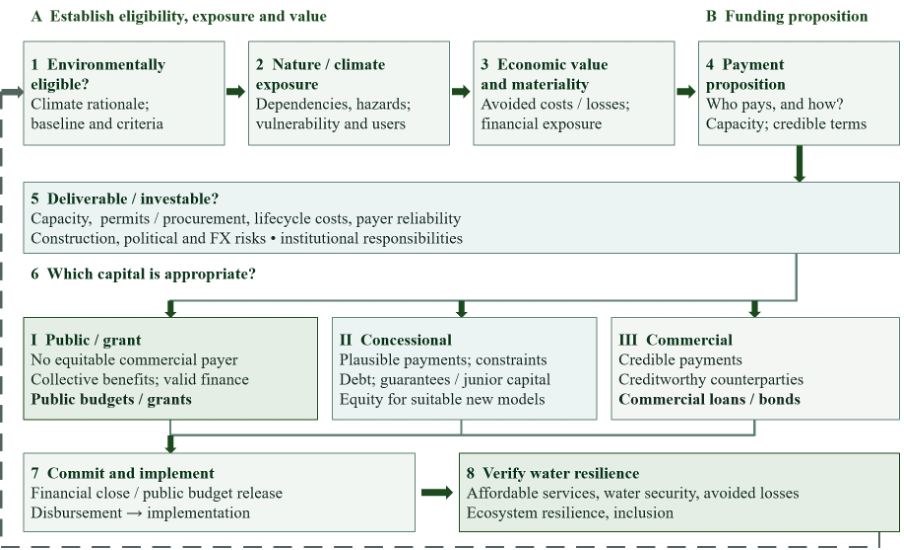
Figure 1. From environmental eligibility to appropriate capital and water resilience (source: author’s illustration)
Matching capital to public purpose
Capital choice should follow economic purpose, repayment capacity and the institutions best placed to manage risk. Public expenditure and grants can sustain activities without a viable commercial payer. Concessional debt may suit plausible repayment constrained by affordability or long maturities. Guarantees and junior capital can address defined risks where they enable additional participation without transferring disproportionate exposure to the public sector. Equity may support suitable new technologies and service models; commercial loans and bonds require credible obligations and creditworthy counterparties.
Blended finance is consequently a targeted instrument, not a universal destination. OECD (2019) identifies the importance of viable business models and institutional conditions in mobilising commercial water finance; OECD (2026) emphasises financing structure, purpose and risk allocation. Preparation must address capable sponsors, mandates, procurement, and construction, political and currency risks. Public support should have a clear rationale, with transparent costs and distributional consequences. Labelling a transaction sustainable cannot replace scrutiny of who receives its benefits, who bears losses and whether services remain affordable.
Country-owned programmes and verified resilience
Country-owned investment platforms could translate national adaptation plans, nationally determined contributions, water strategies and basin priorities into prepared programmes with climate rationales, lifecycle costs, safeguards, institutional responsibilities and measurable outcomes. Climate funds and development finance institutions could support readiness and preparation, then match grants, concessional instruments and commercial participation to those programmes; Green Climate Fund (2025) water guidance provides relevant design principles without making this framework an official fund approach. The United Nations Water Conference, scheduled for 8–10 December 2026 in Abu Dhabi, offers a setting to discuss such connections (UNDESA, 2026). This is a proposed direction, not an adopted conference agenda. Fragile and humanitarian settings require explicit grant-based pathways, while repayment-capable programmes can connect with suitable lenders and investors.
Taxonomies matter because credible definitions support environmental accountability. Their contribution should be judged by additional investment and verified resilience, not classification or labelling alone. Water demonstrates the need to connect eligibility with delivery, translate value into credible payment where appropriate, and match capital to public purpose. Success includes affordable services, avoided losses, ecosystem resilience and inclusion, whether financed commercially or through public budgets and grants.
References
Green Climate Fund. (2025). GCF water project design guidelines Part 1: Practical guidelines for designing water climate resilient projects. https://www.greenclimate.fund/document/gcf-water-project-design-guidelines-part-1
Marchewitz, C., Ballesteros, F., Schütze, F., & Hadj Arab, N. (2026). Sustainable finance taxonomies: Designed to support the transition to a net zero economy? Climate Policy. https://doi.org/10.1080/14693062.2026.2703374
Organisation for Economic Co operation and Development. (2019). Making blended finance work for water and sanitation: Unlocking commercial finance for SDG 6. OECD Publishing. https://doi.org/10.1787/5efc8950-en
Organisation for Economic Co operation and Development. (2020). Developing sustainable finance definitions and taxonomies. OECD Publishing. https://doi.org/10.1787/134a2dbe-en
Organisation for Economic Co operation and Development. (2026). Financing water security: Models and approaches for investments that last. OECD Publishing. https://doi.org/10.1787/7cf3f5bd-en
United Nations Department of Economic and Social Affairs. (2026). 2026 United Nations Water Conference. https://sdgs.un.org/conferences/water2026
United Nations Environment Programme. (2025). Adaptation gap report 2025: Running on empty. https://doi.org/10.59117/20.500.11822/48798
World Bank. (2024). Funding a water secure future: An assessment of public spending. https://www.worldbank.org/en/topic/water/publication/funding-a-water-secure-future
Anchor Environmental Consultants. (2018). Business case for the Greater Cape Town Water Fund. The Nature Conservancy. https://anchorenvironmental.co.za/sites/default/files/2019-02/GCTWF-Business-Case_2018-11-14_Web.pdf
Johannesburg Stock Exchange. (2026). The JSE welcomes Africa’s first nature-linked performance-based bond. https://www.jse.co.za/news/news/jse-welcomes-africas-first-naturelinked-performancebased-bond
Rand Merchant Bank. (2026). RMB launches Africa’s first nature-linked outcomes-based bond. https://www.rmb.com.na/news/rmb-launches-africas-first-naturelinked-outcomesbased-bond
Taskforce on Nature-related Financial Disclosures. (2023). Guidance on the identification and assessment of nature-related issues: The TNFD LEAP approach. TNFD. https://tnfd.global/publication/additional-guidance-on-assessment-of-nature-related-issues-the-leap-approach/
Taskforce on Nature-related Financial Disclosures. (2026). Discussion paper on nature-related risk assessment methods and practices. TNFD. https://tnfd.global/publication/discussion-paper-on-nature-related-risk-assessment/